Fast, Reliable Emergency & Storm Damage Across Spring Valley
When a monsoon cell rolls through the Las Vegas Valley and water starts coming through your ceiling, you don’t have time to wait three days for a callback. Our Emergency & Storm Damage team responds fast to Spring Valley — typically the same day — because we know how quickly a compromised roof can turn a single storm event into a five-figure interior repair. Call (725) 529-9119 now and get a real person on the line, not a voicemail.
Why Total Roof Protection Specialists Is Spring Valley’s Preferred Emergency & Storm Damage Company
We’ve been working roofs across the Las Vegas Valley for 18 years, and Spring Valley makes up a significant share of that work. The housing stock here — dense blocks of 1970s and 1980s single-family homes and low-rise apartment complexes running from Angel Park Lindell down toward the West Flamingo Road corridor — presents failure patterns we know cold. That local knowledge matters when we’re diagnosing why a 40-year-old concrete tile roof leaked during a monsoon even though every tile looked intact from the street.
Jose Diaz doesn’t just run the company — he runs the job. As both Owner and Lead Technician at Total Roof Protection Specialists, Jose is personally on-site for emergency calls, not dispatching a crew he’s never worked with. That’s not common in this industry. It’s why we’ve earned 788 verified reviews at a 4.9-star average — a track record built across hundreds of real jobs in Spring Valley and the surrounding communities, not a handful of hand-selected testimonials.
Response time to Spring Valley is fast. Our crews stage from Las Vegas, which puts us within a short drive of the 89103 zip code and the neighborhoods along West Sahara Avenue and East Charleston Boulevard. When a storm hits at 9 p.m. on a Tuesday, we show up that night with tarps and equipment — not a “we’ll be there sometime next week” estimate.
Our Emergency & Storm Damage Services in Spring Valley
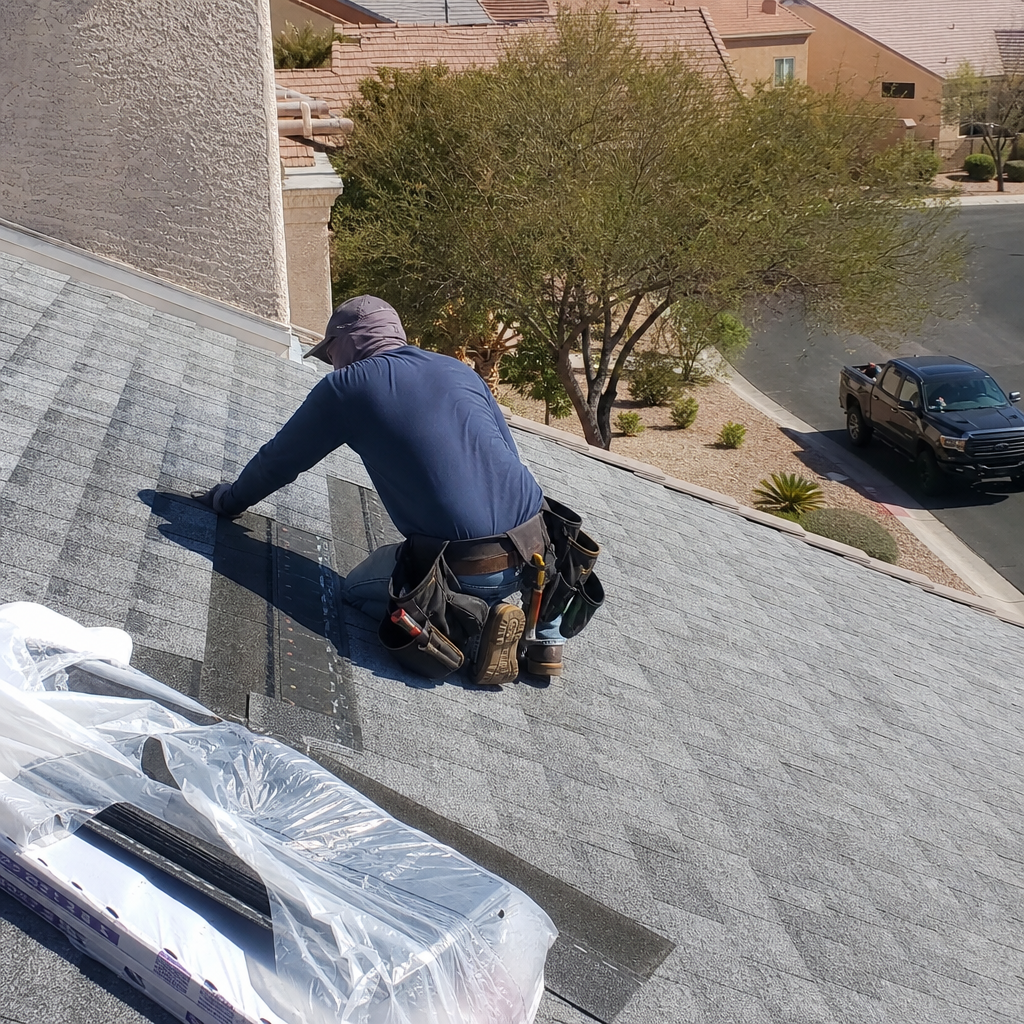
Storm Damage Repair
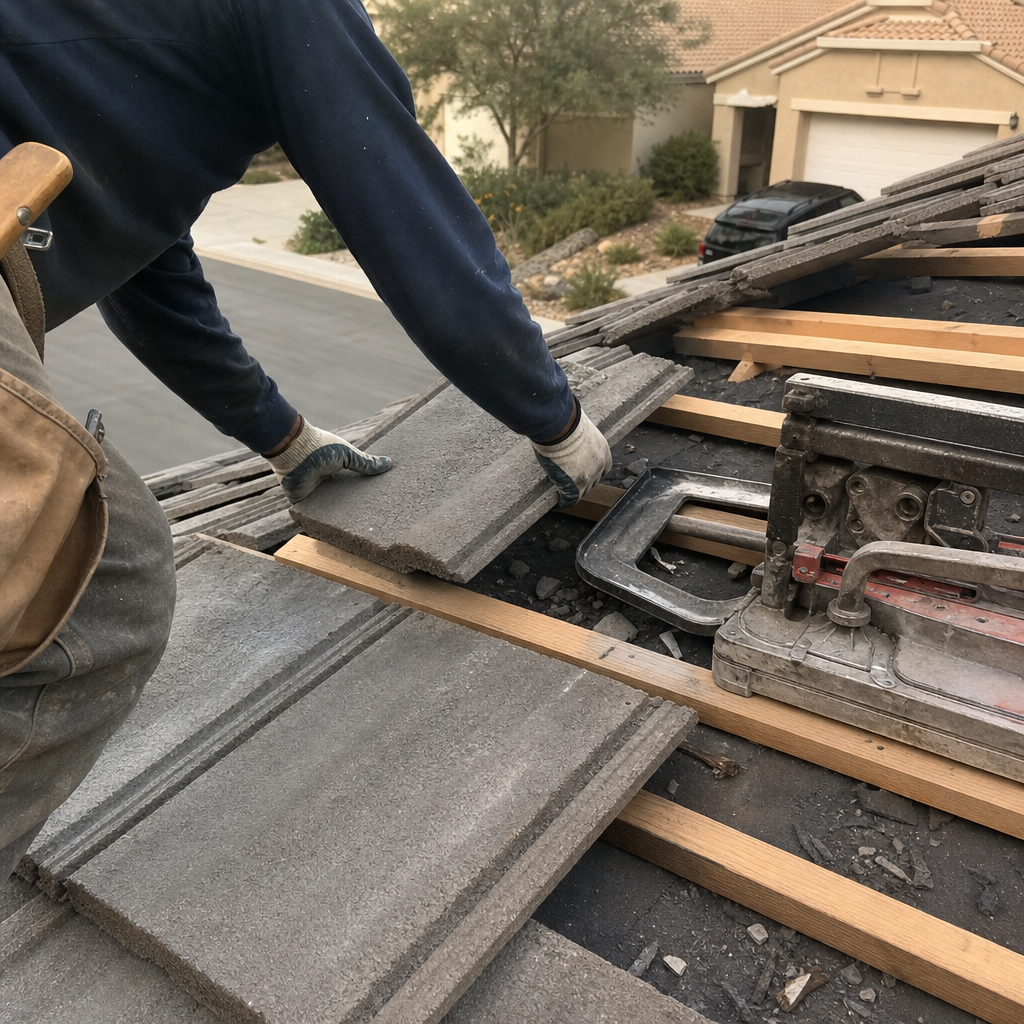
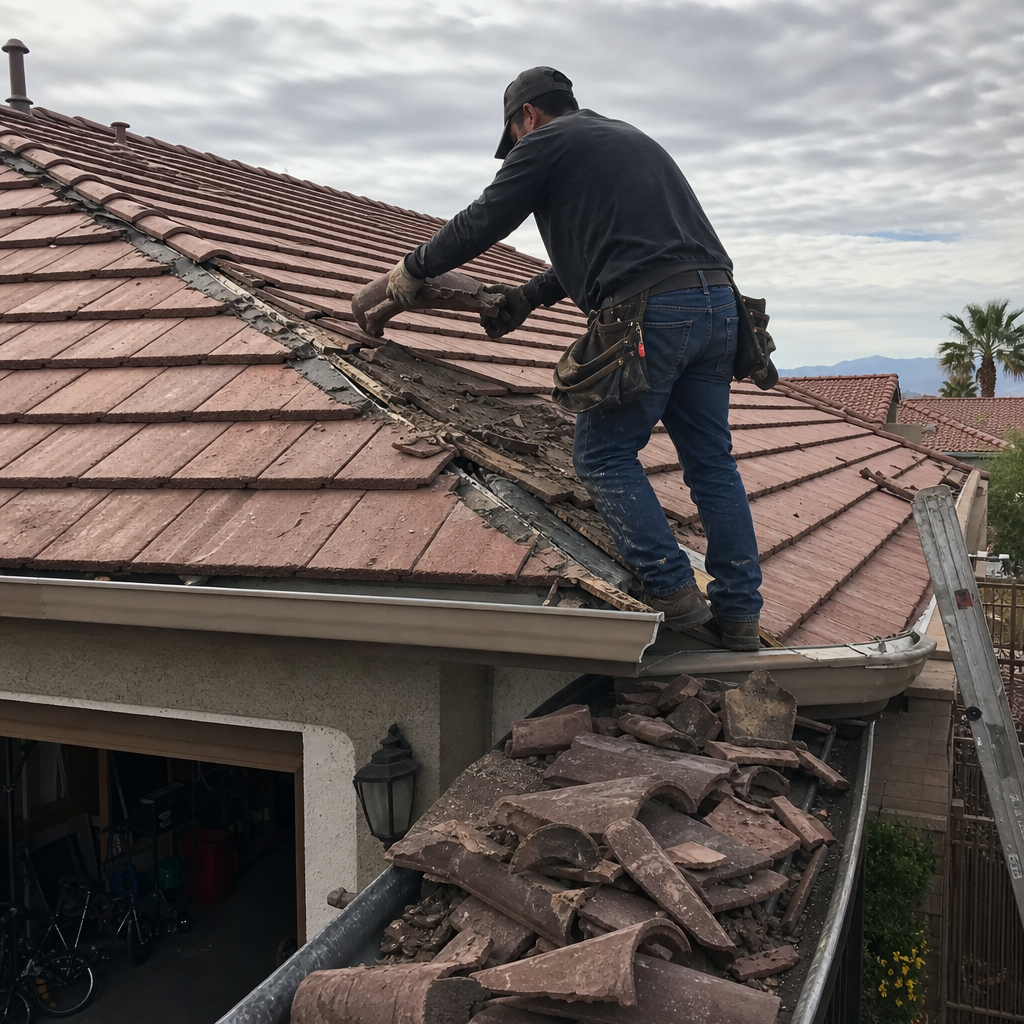
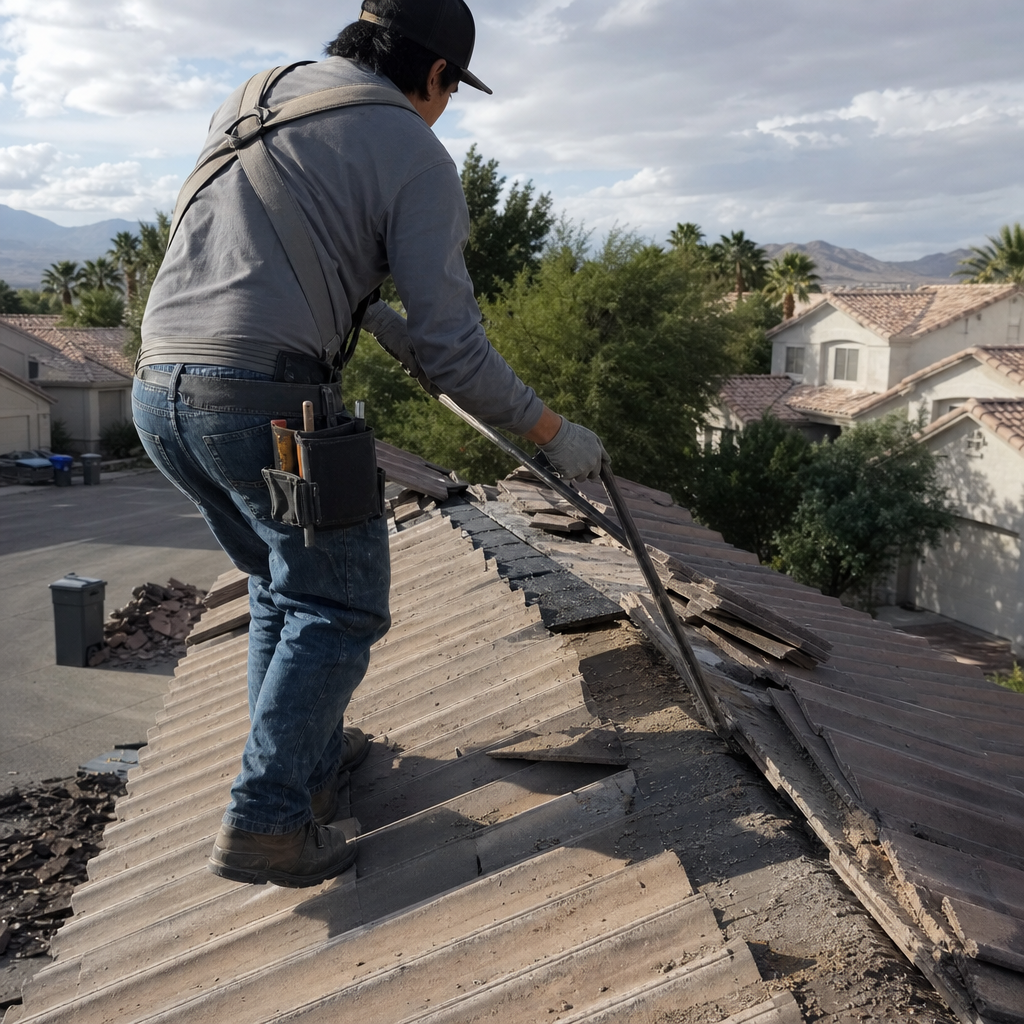
Storm damage repair in Spring Valley almost always involves more than what’s visible from the ground. The most common scenario we encounter: a homeowner in Buffalo Ranch or Canyon Gate calls after a monsoon, certain a tile must have blown off. When we get on the roof, the tiles are all there — the problem is a 35-year-old felt underlayment that quietly gave out under sustained 150°F+ roof-surface temperatures. We perform full diagnostic inspections before quoting any repair, because fixing the surface while the substrate is gone is just billing you twice. Every repair is documented with photos, which matters enormously if an insurance claim follows.
Emergency Tarp Installation
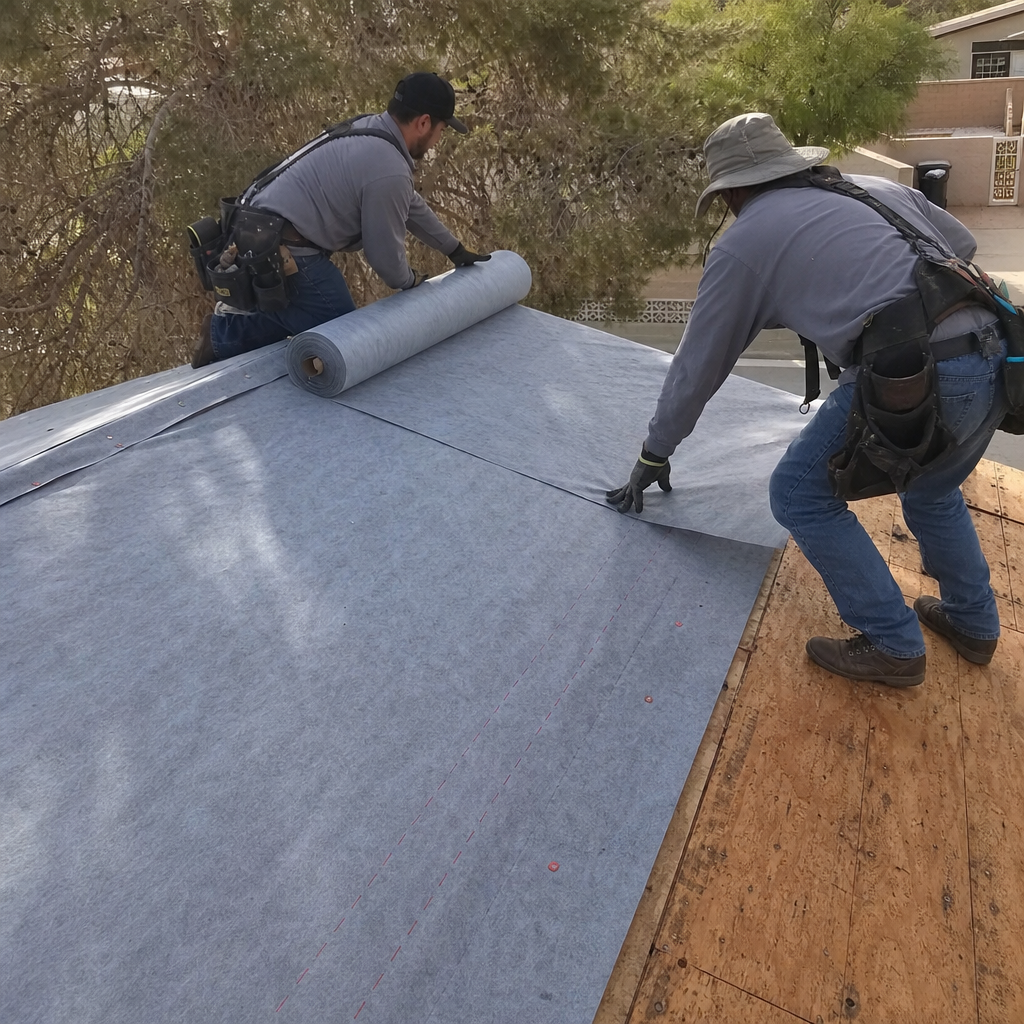
An emergency tarp deployed correctly stops the bleeding. We hear from Spring Valley homeowners who were told by a previous contractor to “just put a tarp on it” — and the tarp was stapled over an active wet area with no ventilation, trapping moisture and accelerating deck rot. We do it differently: we assess the full compromised section, use weighted and mechanically fastened tarping designed to survive additional wind events, and document what’s underneath for the insurance adjuster. A properly installed tarp buys you the time to do the repair right, without making the damage worse. A typical emergency tarp deployment in Spring Valley runs $350–$700 depending on roof slope, square footage covered, and accessibility.
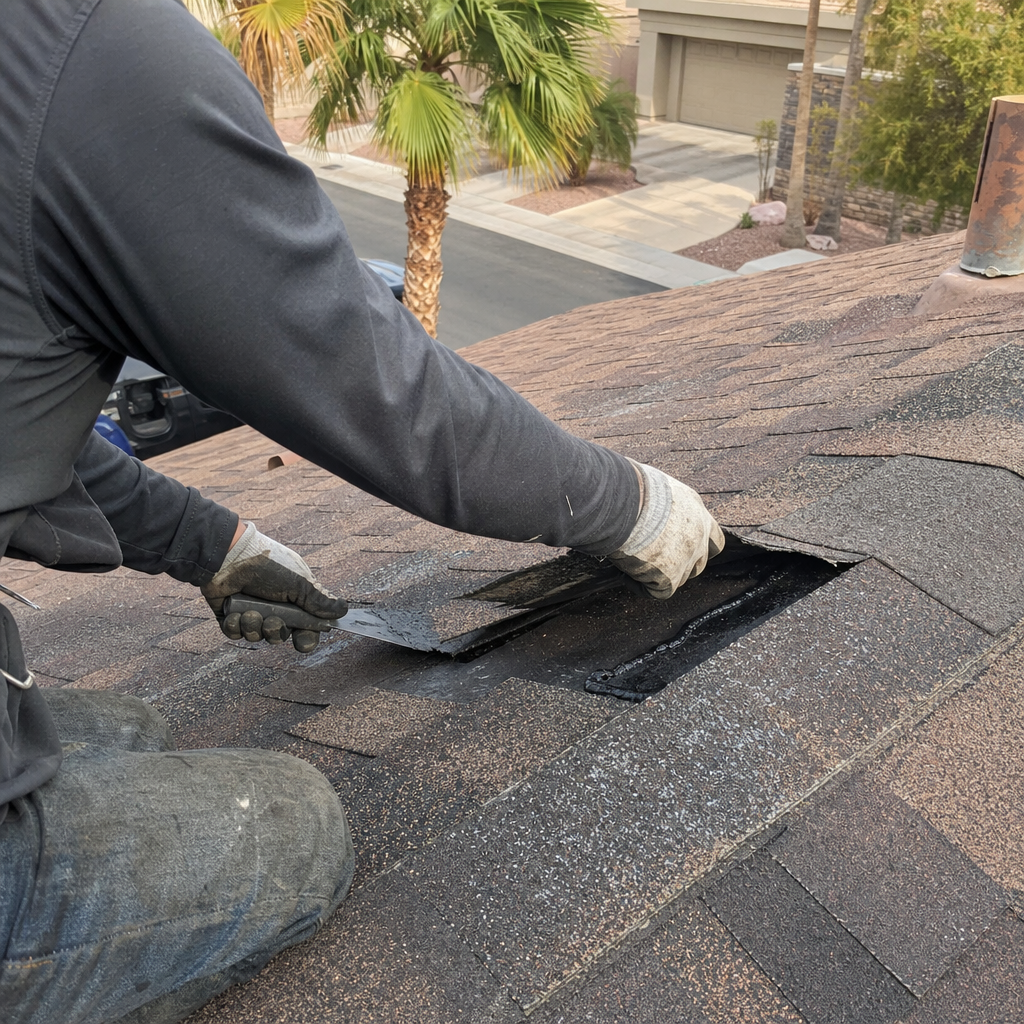
Insurance Claims Assistance
Filing a roof damage claim after a monsoon event is a process most Spring Valley homeowners have never done before, and insurance adjusters are not always looking for the same damage we are. We work directly with homeowners and their adjusters, providing detailed photo documentation, written scope-of-damage reports, and accurate repair estimates that reflect real Spring Valley market costs — not low-ball numbers that leave you short when the contractor bill arrives. Jose Diaz has handled insurance claim coordination on both residential properties and the older garden-style apartment complexes common along the West Flamingo Road corridor, and he knows what documentation adjusters need to approve a full underlayment replacement, not just a surface patch.
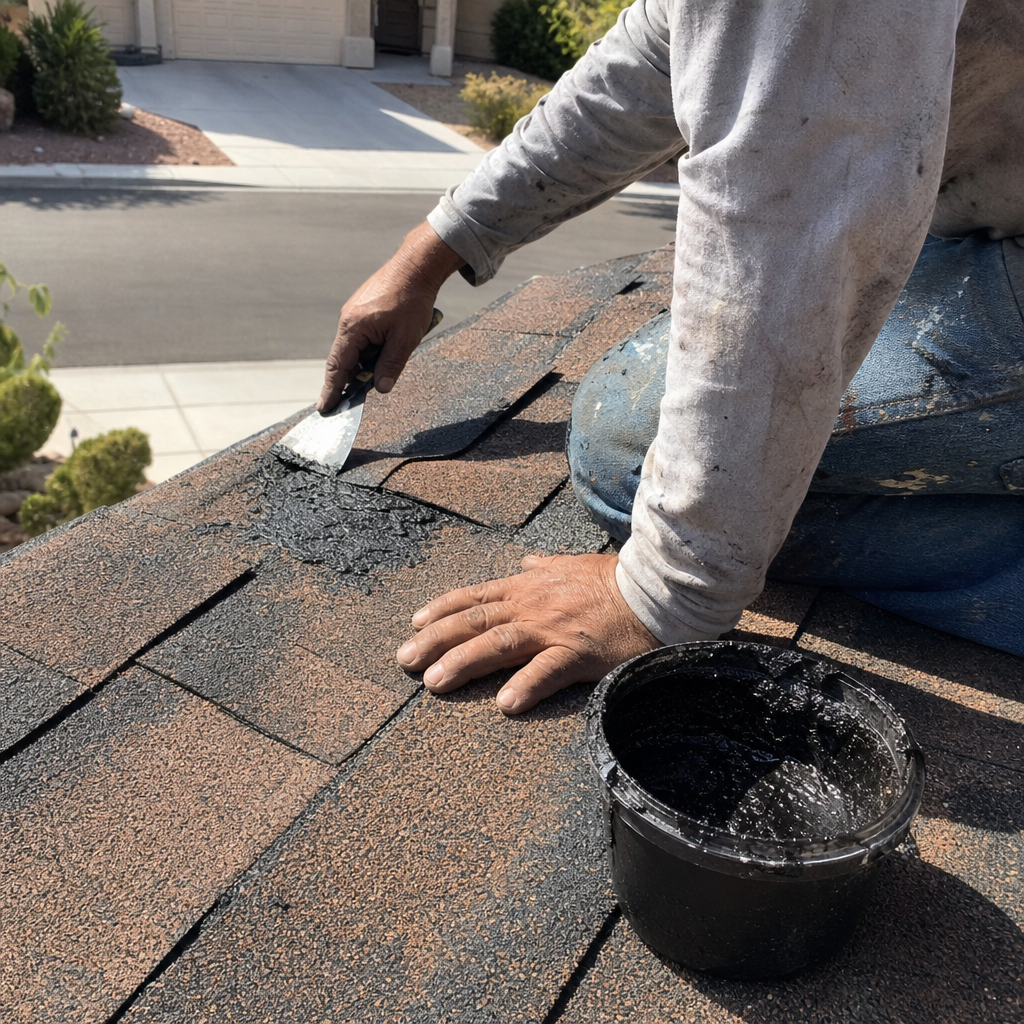
Wind Damage Repair
The Las Vegas Valley generates serious wind events outside of monsoon season — particularly during spring and fall when pressure differentials send sustained gusts across the valley floor. On older Spring Valley concrete tile roofs near West Sahara Avenue, ridge and hip mortar that’s been through decades of thermal cycling is frequently the first thing to fail in a wind event. The mortar looks intact, but it has micro-fractured and no longer bonds the cap tiles to the ridge. When wind-driven rain follows, it funnels straight into the roof deck at exactly those ridge penetration points. We repair the mortar line properly — not just re-tile the surface — so the same section doesn’t fail in the next storm.
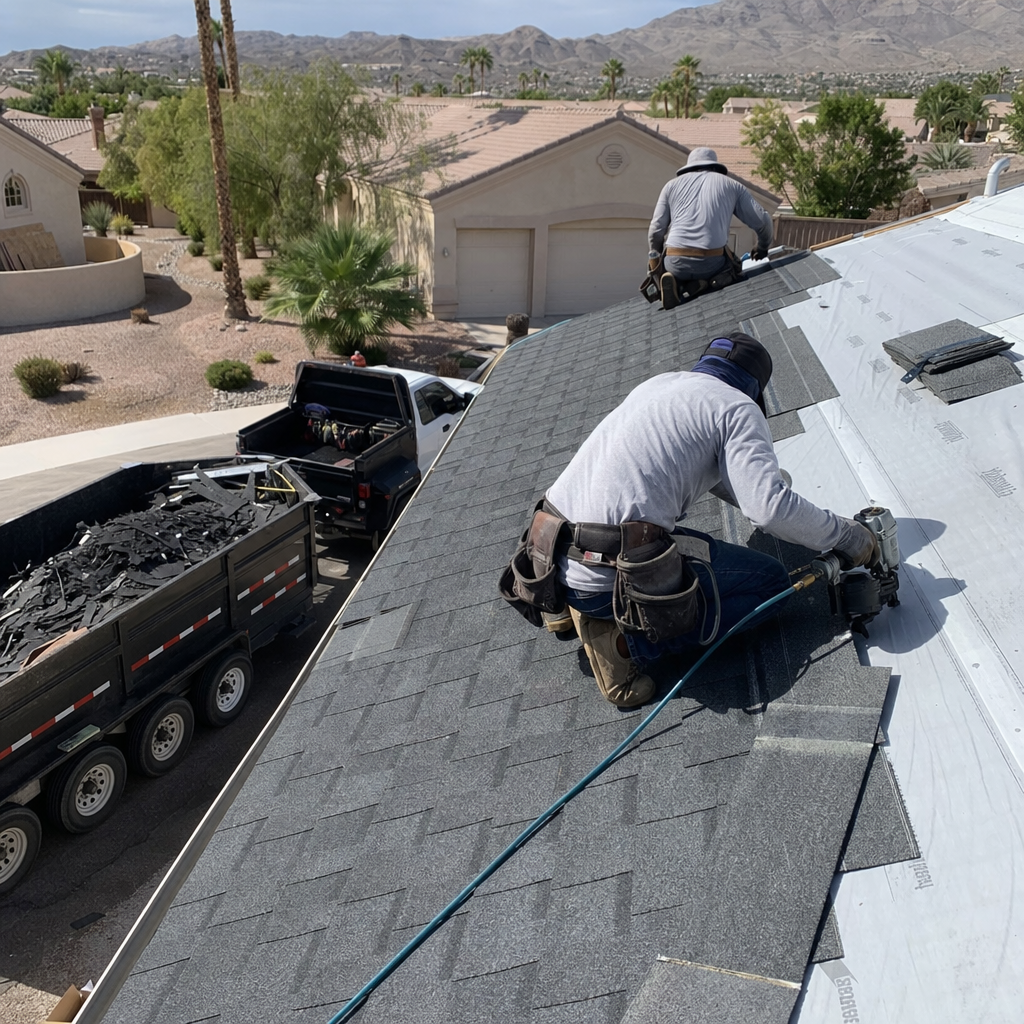
Hail Damage Assessment
Hail events are less frequent in Spring Valley than wind and monsoon rain, but when they occur, concrete tile roofs take impact damage that isn’t always obvious at ground level. Surface cracking, bruising to the underlayment, and granule loss on any modified bitumen sections all require a professional eye. We document every impact point with close-range photography specifically formatted for insurance carrier submission.
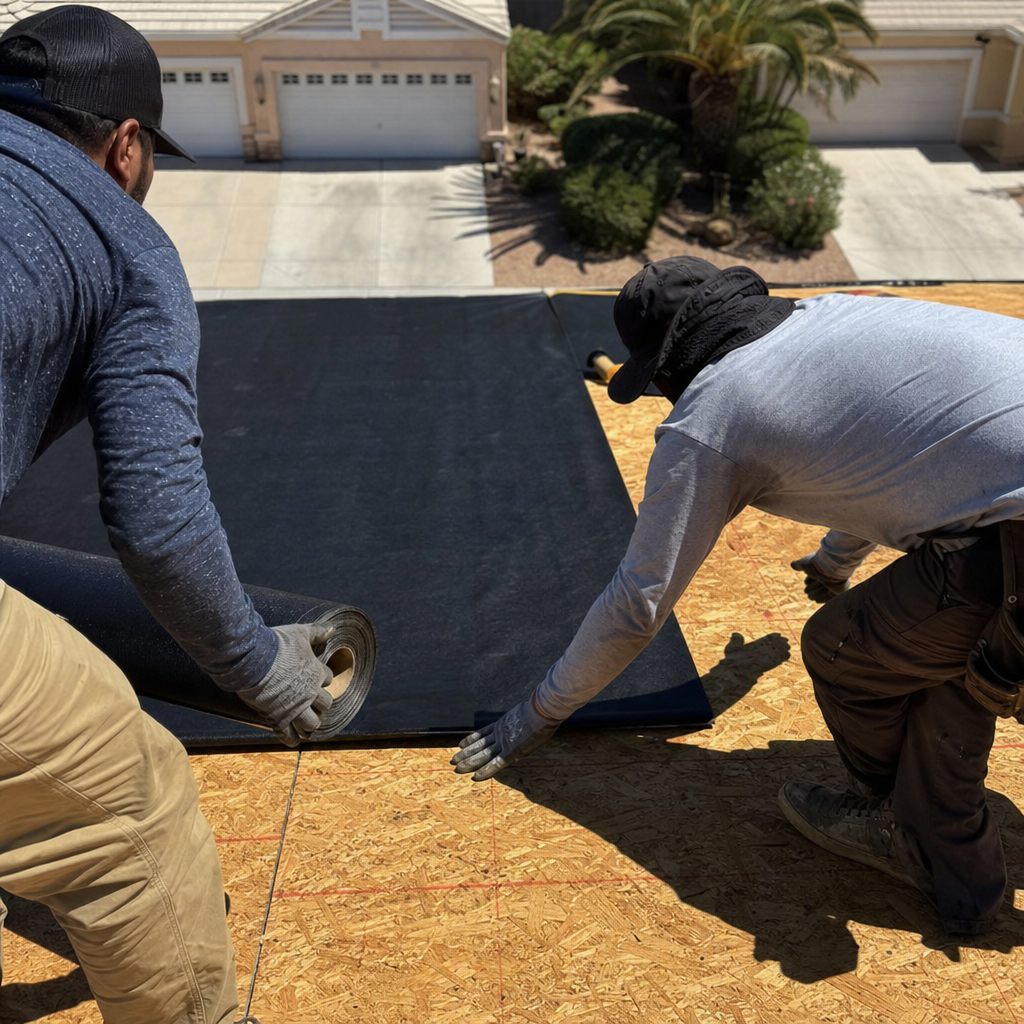
Tree and Debris Damage
Spring Valley’s older residential blocks — particularly around the Madison Playground and Ronzone Playground neighborhoods — have mature landscaping. In a high-wind event, limb strikes on aging tile roofs can crack multiple tiles and the deck below simultaneously. We assess structural damage to the sheathing, not just the visible surface, before any repair scope is written.
What happens when you call
- 1
A real person answersNo phone trees — you reach a local pro.
- 2
You get an upfront price rangeHonest numbers before anyone is dispatched.
- 3
A background-checked tech heads outLicensed & insured, dispatched right away.
- 4
You approve before work beginsNothing starts until you say go.
The Silent Underlayment Crisis in Spring Valley — What Generic Storm Damage Pages Won’t Tell You
This is the defining roofing issue in Spring Valley, and it’s almost never discussed plainly. Spring Valley was built out primarily between the mid-1970s and early 1990s as a bedroom community for workers along the Strip corridor. The overwhelming majority of single-family homes in neighborhoods like Angel Park Lindell, Canyon Gate, and Buffalo Ranch were roofed with concrete tile over a standard organic felt underlayment. That underlayment was designed for a 20–25 year service life. In the Las Vegas Valley’s UV environment — where roof surface temperatures routinely hit 150°F to 170°F in summer — that lifespan often runs shorter. The math is not complicated: homes built in 1982 with a 20-year underlayment were overdue before 2005. In 2026, those roofs are running on nothing.
The cruel part is the tile itself doesn’t show it. Concrete tile is dense and durable; it can look flawless from West Flamingo Road for decades after the membrane beneath it has completely degraded. Homeowners are genuinely blindsided when a July monsoon that drops less than an inch of rain causes a ceiling to fail — because the roof “looked fine.” It did look fine. The tiles were fine. But the underlayment that actually waterproofs the roof deck was gone. This failure mode is specific to Spring Valley’s build era and does not affect newer construction in Summerlin to the northwest, where roofing materials and underlayment systems are current-generation. If your Spring Valley home was built before 1995 and has never had an underlayment inspection, monsoon season is not the time to find out what’s there.
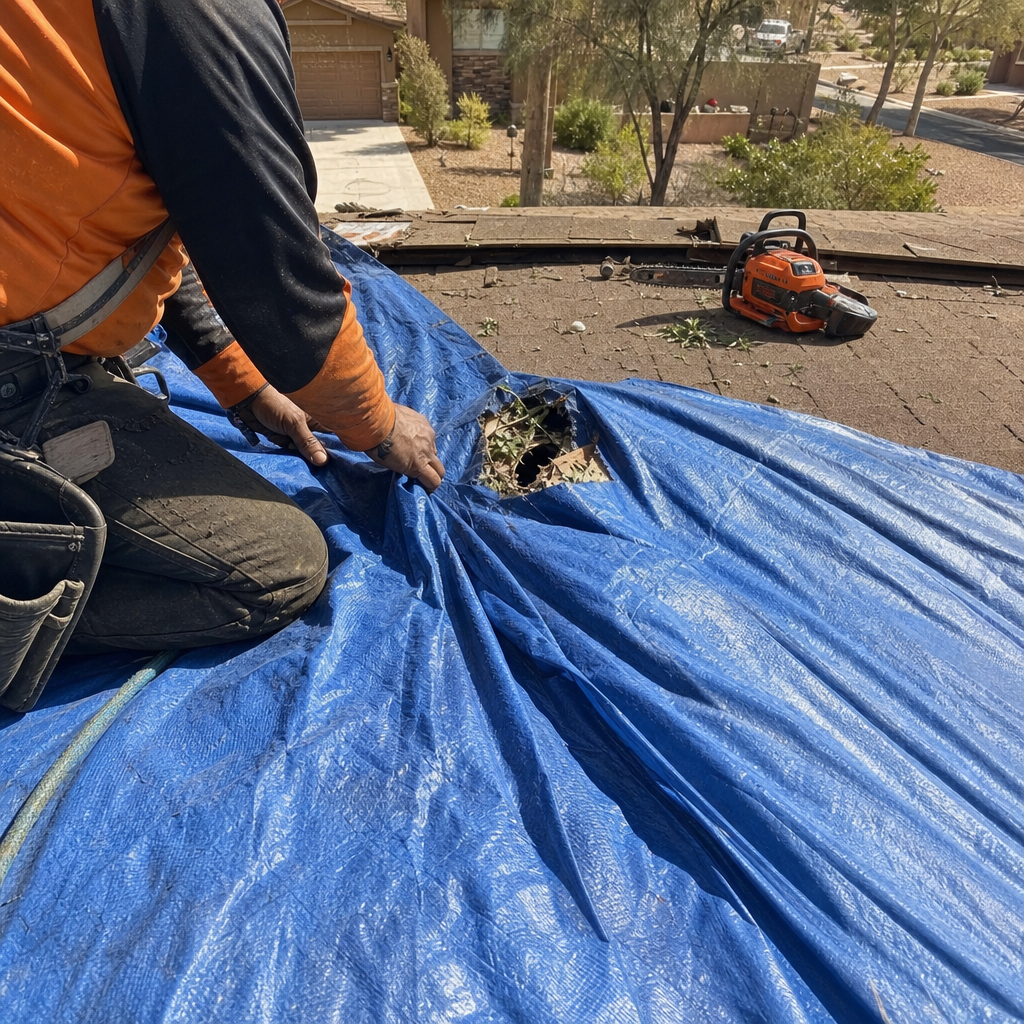
A Real Spring Valley Emergency Call — What We Saw on West Flamingo Road
Our crew responded to an emergency call on West Flamingo Road after a late-August monsoon cell dropped nearly an inch of rain in under 30 minutes. The flat, gravel-surfaced built-up roof on a 1980s garden-style apartment complex had clogged interior drains that caused rapid ponding, and water backed up through a failed seam straight into a second-floor unit ceiling. We deployed emergency tarping over the compromised membrane section that night, cleared the blocked drains, and documented the full scope of ponding-related damage with photo evidence for the ownership group’s insurance claim the following morning. The damage was real and significant. The drain cleaning that could have prevented the entire event would have cost a fraction of the claim.
On the older low-rise commercial strips and apartment complexes along West Flamingo Road and South Decatur Boulevard, original 1970s–1980s gravel-surfaced built-up roofing is still in place on many buildings. Clogged interior drains — packed with desert debris accumulated over a dry spring and early summer — make those roofs predictable emergency calls every August. We start preparing for that surge each July, because experienced Spring Valley roofers know exactly when those phones will start ringing.
Common Emergency & Storm Damage Problems We See in Spring Valley Homes
- Silent underlayment failure beneath intact concrete tile: Thousands of Spring Valley homes in Canyon Gate, Buffalo Ranch, and Angel Park Lindell have concrete tile roofs whose original felt underlayment has fully degraded from decades of 150°F+ roof-surface exposure. The tiles show no visible damage from the street, but a single monsoon event breaches the deck — homeowners are consistently blindsided because there was no visible warning.
- Ridge and hip mortar fracturing on older tile roofs: The extreme thermal cycling on roofs near West Sahara Avenue — baking to 160°F by afternoon, cooling sharply overnight — cracks the mortar bedding that locks cap tiles at the ridge and hip lines. Wind-driven monsoon rain then enters at exactly those points. Homeowners typically blame a missing tile when the actual failure is the mortar bond, and patching tiles without repointing the mortar line solves nothing.
- Flat roof ponding on 1970s–1980s commercial and apartment buildings: Original gravel-surfaced built-up roofing along the West Flamingo Road corridor collects debris through spring and summer, blocking interior drains. The first serious monsoon event then overwhelms the drainage system, produces rapid ponding, and forces emergency calls that were entirely preventable with pre-monsoon drain clearing and membrane inspection.
- Low-pitch flat section failures on 1- and 2-story homes: Many Spring Valley homes from this era include low-slope or flat sections — patio covers, add-on rooms, attached garages — with original built-up or foam-coated surfaces. These sections degrade faster than the main tile roof and frequently show active leaks during monsoon season while the primary roof surface holds. They’re easy to overlook in a surface-only inspection.
Trusted Brands We Work With in Spring Valley
Spring Valley’s roofing needs span a wide age range of materials and systems, so material flexibility matters. We install and work with GAF, CertainTeed, Owens Corning, IKO, Atlas, Tamko, and Boral — seven of the industry’s leading brands. That means when an older Spring Valley home needs an underlayment replacement beneath existing concrete tile, or a flat roof section needs a new membrane system, we’re selecting the right product for that specific roof and budget — not defaulting to whatever’s on the truck. For Spring Valley homeowners dealing with emergency damage, this also means we can often source materials faster, which keeps repair timelines tight.
Pricing for Emergency & Storm Damage in Spring Valley, NV
Spring Valley pricing for emergency and storm damage work reflects the age and complexity of the local housing stock. Here’s what you can expect for common services in the 89103 market:
- Emergency tarp installation: $350–$700 depending on roof slope, coverage area, and accessibility
- Storm damage inspection and written report: $150–$300 (often applied toward repair cost)
- Ridge and hip mortar repair (linear footage): $8–$18 per linear foot; a full ridge line on a typical Spring Valley home runs $600–$1,800
- Concrete tile underlayment replacement (full roof): $4,500–$9,500 depending on roof size and pitch — this is the most common major repair in Spring Valley’s 1970s–1990s housing stock
- Flat/BUR section repair or re-coating: $1,200–$4,000 depending on square footage and membrane condition
- Tree or debris damage repair (localized): $400–$2,500 depending on deck damage and tile replacement required
Insurance-covered repairs follow a separate process — we provide documentation to support your claim, and the out-of-pocket cost depends on your deductible and coverage. Call (725) 529-9119 for a free on-site estimate; we’ll give you a specific number after we’re on the roof, not a range pulled from thin air.
We Also Serve Cities Near Spring Valley
Along with Spring Valley, Total Roof Protection Specialists provides emergency and storm damage response across Las Vegas, Winchester, Paradise, and Whitney. If you’re just outside Spring Valley in any of these neighboring communities and need fast storm response, we cover your area with the same response times and the same hands-on oversight from Jose Diaz on every job.
Serving Spring Valley, NV — Our Local Coverage Area
We’re based in the Spring Valley area and know this community well. Use the map below to see our service coverage — if you’re nearby, we can almost certainly help.
FAQs — Emergency & Storm Damage in Spring Valley
The tiles are not the waterproofing layer — the underlayment beneath them is, and on a 1980s Spring Valley home, that underlayment is almost certainly past its service life. Concrete tile can look flawless for decades after the original felt underlayment has fully degraded under the Las Vegas Valley’s extreme UV load and 150°F+ roof-surface temperatures. The tile holds its color and shape; the membrane underneath quietly fails. When a monsoon delivers a sharp inch of rain in 30 minutes, there’s nothing stopping the water from reaching the deck. This is the most common root cause of emergency calls we receive in Spring Valley’s Canyon Gate, Buffalo Ranch, and Angel Park Lindell neighborhoods. Call (725) 529-9119 to schedule a proper underlayment inspection before the next storm hits.
Yes — insurance claim assistance is a core part of how we respond to storm damage in Spring Valley, not a side service. We provide detailed photo documentation, a written damage scope, and repair estimates formatted the way insurance adjusters need to see them. Jose Diaz handles this process directly, including coordination on the older apartment complexes and commercial properties along the West Flamingo Road corridor where damage assessment is more complex. Carriers regularly attempt to approve surface-only repairs on underlayment failures — we document the full scope so you’re not left paying out of pocket for work your policy should cover. Call (725) 529-9119 to get the documentation process started.
Emergency tarping is a legitimate and necessary first step when it’s done correctly. A properly installed tarp — weighted and mechanically fastened across the full compromised section — stops active water intrusion and buys time for a permanent repair without allowing additional moisture to enter the structure. What makes it worse is sloppy installation: a tarp stapled over an active wet area with no ventilation traps moisture and accelerates deck rot and mold growth underneath. We assess the full damaged zone before tarping, document what’s beneath for the insurance adjuster, and install the tarp to survive additional wind and rain events. It’s a stop-gap, yes — but a well-executed one that protects the repair scope rather than expanding it. Call (725) 529-9119 for same-day tarp deployment in Spring Valley.
It’s both, and in Spring Valley’s older apartment stock it’s a predictable combination. The standing water is almost certainly caused by clogged interior drains — debris accumulates on these flat, gravel-surfaced built-up roofs all spring and summer, and the first heavy monsoon overwhelms the drainage system instantly. But ponding water on a degraded 1980s BUR membrane is also an active roofing emergency: once water backs up through a failed seam or blister, it enters the building fast. The right response is drain clearing, full membrane assessment, emergency tarping of any compromised sections, and damage documentation for insurance — all at once, that night, not sequentially over several days. Call (725) 529-9119 and we’ll dispatch the same evening for West Flamingo Road and surrounding areas.
For Spring Valley, our typical same-day response covers the full 89103 zip code — from properties along East Charleston Boulevard and West Sahara Avenue to the residential blocks near Bruce Woodbury Beltway. Neighborhood does not create a meaningful difference in response time within Spring Valley; we’re positioned to reach any part of the community quickly. For active emergency calls — active water intrusion, ceiling failures, fresh storm damage — we prioritize same-day response as a standard, not an exception. Call (725) 529-9119 directly; we pick up, assess your situation on the call, and give you an honest arrival window on the spot.
Reviewed by Jose Diaz, Owner & Lead Technician at Total Roof Protection Specialists, serving Spring Valley and the greater Las Vegas Valley since 2007.