
Last updated June 27, 2026
The Complete Guide to Roofing in Las Vegas
Las Vegas averages 294 sunny days a year, and most homeowners assume that relentless UV exposure is the number one killer of roofs here. It isn’t. The leading cause of premature roof failure in Las Vegas is improper attic ventilation — a problem that bakes shingle adhesive from the inside out, quietly destroys decking, and costs homeowners thousands before a single visible symptom appears on the surface. This guide covers everything a Las Vegas homeowner needs to know: the climate realities that make this market genuinely different from other desert cities, the material decisions that matter, the code requirements you can’t ignore, and the inspection and maintenance steps that actually extend a roof’s life in our specific conditions.
Quick Answer
Roofing in Las Vegas requires decisions that differ meaningfully from other hot climates. Between extreme UV exposure, attic temperatures that regularly exceed 160°F, a short but damaging monsoon season, and Clark County cool-roof energy code requirements, the right roof here is one engineered specifically for this environment — not just any product rated for “hot climates.” A qualified Las Vegas roofing contractor will assess ventilation ratios, slope transitions, material cool-roof compliance, and drainage before recommending anything.
Table of Contents
- Why Attic Ventilation Is Las Vegas’s #1 Roofing Problem
- Roofing Materials: What Actually Lasts in Las Vegas
- Cool Roof Compliance and Clark County Energy Code
- The Flat-to-Low-Slope Transition Problem on Las Vegas Tract Homes
- Monsoon Season and Ponding Water on Low-Slope Roofs
- The Real Lifespan of a “30-Year Shingle” in Las Vegas
- How to Inspect and Maintain Your Las Vegas Roof
- Common Mistakes to Avoid
- When to Call a Professional
- Frequently Asked Questions
- The Bottom Line
Why Attic Ventilation Is Las Vegas’s #1 Roofing Problem
Here’s what most roofing guides skip entirely: on a 115°F Las Vegas summer afternoon, an under-ventilated attic doesn’t just get warm — it reaches 160°F to 180°F routinely. At those temperatures, the thermally activated adhesive strips on asphalt shingles soften and fail. That failure doesn’t look like a missing shingle right away. It looks like shingles that slowly curl, blister, and lose granules three to five years ahead of schedule, leaving homeowners confused about why a “new” roof is already deteriorating.
The industry standard for attic ventilation is a net-free ventilation area (NFVA) ratio of 1:150 — one square foot of ventilation for every 150 square feet of attic floor space — and that ratio assumes a balanced split between intake (soffit) and exhaust (ridge or gable). In our experience working on homes across the Las Vegas valley, a large percentage of homes we inspect are running a ratio closer to 1:300 or worse, often because builders installed ridge vents without corresponding soffit vent capacity, creating a system that can’t actually move air.
The fix isn’t always a full re-roof. In many cases, adding continuous soffit venting, upgrading to a high-flow ridge vent, or installing power attic ventilators calibrated for the square footage can reduce attic temps by 40°F to 50°F — meaningfully extending whatever roof system is already up there. If you’re doing a full replacement, this is the moment to address ventilation, because installing new materials over the same broken thermal environment just starts the clock on the same failure all over again.
- Signs of poor ventilation: Shingles blistering or buckling on south- and west-facing slopes
- Signs of poor ventilation: Granule loss concentrated in the upper third of the slope
- Signs of poor ventilation: Attic decking that feels soft or shows dark discoloration when inspected in fall
- Signs of poor ventilation: HVAC bills that seem disproportionately high for the home’s square footage
Roofing Materials: What Actually Lasts in Las Vegas
Not every roofing product on the market is engineered to perform in the Mojave. Here’s an honest breakdown of the materials we see perform well — and the ones we see fail prematurely — in Las Vegas conditions.
Asphalt Architectural Shingles
The most common roofing material in Las Vegas residential construction. When properly ventilated and installed, a quality architectural shingle from GAF, CertainTeed, Owens Corning, IKO, Atlas, or Tamko will provide solid performance. The key differentiator in this climate is the shingle’s solar reflectance index (SRI) and granule quality. Premium lines from these manufacturers use ceramic-coated granules that reflect more UV and retain color longer than standard lines. We specify these for every replacement we do here.
Concrete and Clay Tile
Tile is genuinely well-suited to Las Vegas conditions. The thermal mass of concrete and clay moderates heat transfer into the attic, and tile systems allow natural airflow underneath the tile layer itself — effectively a built-in ventilation advantage. Boral is a manufacturer we work with regularly for tile systems, and their products hold up exceptionally well under sustained UV exposure. The trade-off is weight: homes built in the 1980s and early 1990s often need a structural assessment before a tile system is added.
Flat and Low-Slope Membrane Systems
TPO (thermoplastic polyolefin) and modified bitumen are the dominant flat-roof materials in Las Vegas. White-membrane TPO has strong cool-roof credentials and handles the thermal cycling — day-to-night temperature swings of 40°F to 50°F — better than older built-up roofing (BUR) systems. Modified bitumen with a granulated surface cap sheet is a proven option for low slopes on tract homes, provided it’s installed with proper drainage slope engineered in.
Metal Roofing
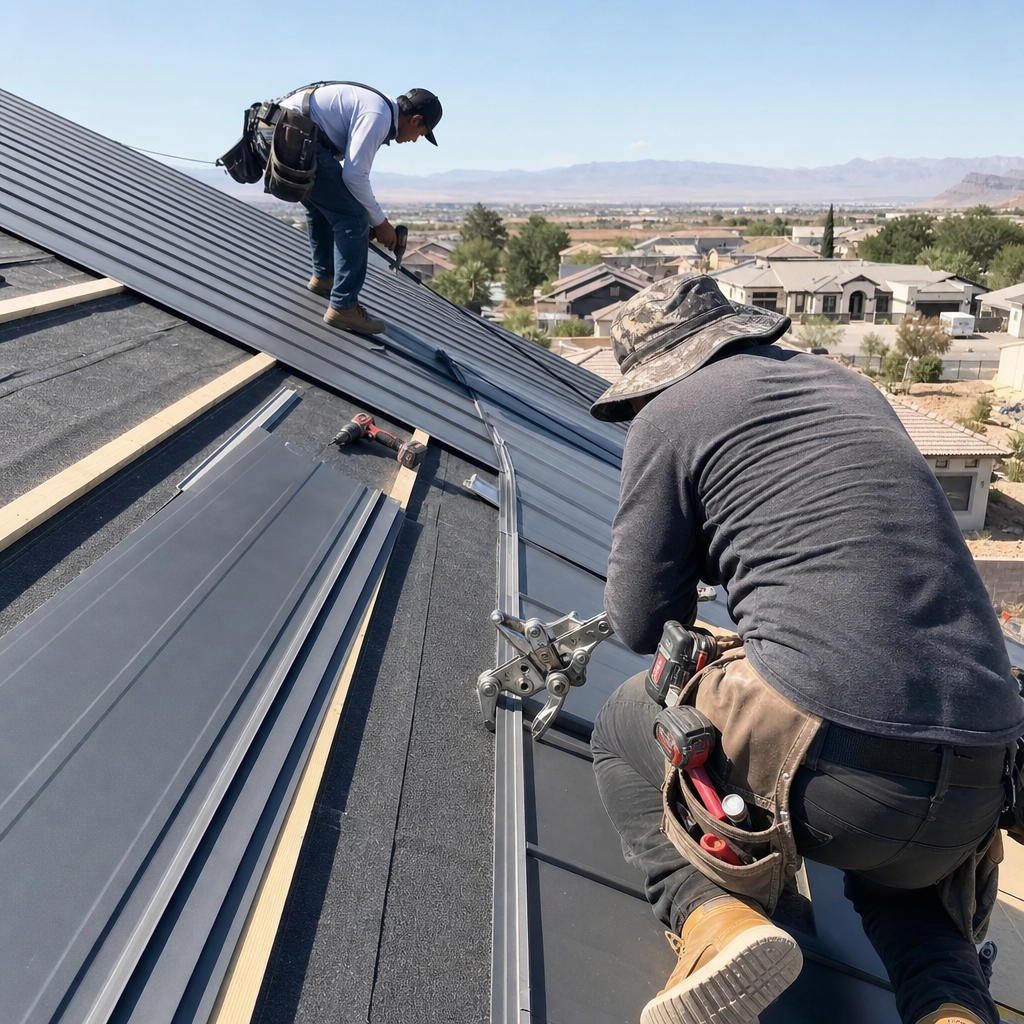
Standing seam metal performs extremely well here. It handles UV, thermal cycling, and monsoon rain without absorbing moisture, and its lifespan in Las Vegas conditions significantly outpaces asphalt. The upfront cost is higher, but when amortized over a 40-plus-year service life, the math often works in its favor — particularly for homeowners who plan to stay long-term.
Cool Roof Compliance and Clark County Energy Code
Clark County and the City of Las Vegas enforce energy code requirements tied to roof solar reflectance and thermal emittance — commonly called “cool roof” requirements. These requirements apply to new construction and, critically, to full roof replacements on existing structures above a certain square footage threshold. Installing a non-compliant product on a replacement isn’t just a code issue — it can affect your ability to close a permit and, in some cases, your homeowner’s insurance coverage.
Here’s what to look for when reviewing a material spec sheet for compliance:
- Initial Solar Reflectance (SR): For low-slope roofs (≤ 2:12 pitch), Clark County’s energy code aligns with Title 24 and IECC standards, typically requiring an initial SR of 0.70 or higher and a three-year aged SR of 0.55 or higher. Check the product’s CRRC (Cool Roof Rating Council) certified rating — not just the manufacturer’s marketing language.
- Thermal Emittance (TE): A minimum of 0.75 is the common threshold for low-slope applications. This measures how efficiently the roof radiates absorbed heat back out.
- SRI (Solar Reflectance Index): Combines SR and TE into a single number. For steep-slope (residential pitched) roofs, Nevada’s current energy code requirements are less stringent, but products that meet the low-slope threshold generally exceed what’s needed for pitched applications.
- CRRC Rating Label: Any compliant product will carry a CRRC product number. Require this from your contractor before materials are ordered — not after they’re on the truck.
- Permit Pull Confirmation: A reputable contractor pulls the permit and has the material’s compliance documentation ready for the inspector. If a contractor suggests skipping the permit on a full replacement, that’s a hard stop.
Products from GAF’s Timberline Cool Series, CertainTeed’s Landmark Solaris, and Owens Corning’s Duration Cool lines all carry CRRC ratings that satisfy Clark County requirements. We verify compliance on every replacement project before a single bundle is ordered.
The Flat-to-Low-Slope Transition Problem on Las Vegas Tract Homes
Drive through any established neighborhood in the Las Vegas valley — Sunrise Manor, Whitney Ranch, the older sections of Henderson, Spring Valley — and you’ll notice a common architectural feature: a pitched shingle section that terminates into a flat or low-slope section over a covered patio, garage, or rear addition. This transition point is one of the most chronic leak sources we see, and it’s almost never addressed in basic inspections.
The failure mechanism works like this: the pitched shingle slope sheds water fast, channeling it toward the transition flashing at the base of the wall or step. The flat section behind that transition has a drainage slope of 1/4 inch per foot or less — sometimes none at all on older pours. When that flat section’s membrane or modified bitumen cap sheet ages, cracks, or loses adhesion at seams, water doesn’t run off. It sits. And it finds any penetration point — the transition flashing, the pitch pan around HVAC curbs, the perimeter edge — and works its way in slowly, often showing up as a water stain on the ceiling of the room directly below, sometimes months after the entry point first opened.
The correct repair for this transition involves:
- Removing and replacing the step flashing at the base of the pitched slope where it meets the flat section
- Extending a new membrane underlayment beneath the last two courses of shingles on the pitched section to create a continuous waterproof plane
- Installing a new flat membrane with a minimum 4-inch overlap onto the vertical wall surface and sealing with compatible adhesive and termination bar
- Re-sloping the flat section if standing water is observed — even 1/4 inch per foot eliminates most ponding risk
Half-measures — caulk over existing flashing, a patch coat of rubberized paint — typically last one to two monsoon seasons before failing again. If you’re seeing recurring stains in the same ceiling location, the transition assembly needs a proper rebuild, not another patch.
Monsoon Season and Ponding Water on Low-Slope Roofs
Las Vegas’s monsoon micro-season runs roughly from early July through mid-September. In that roughly ten-week window, the valley receives the majority of its annual precipitation — and unlike winter rains, which tend to fall steadily over extended periods, monsoon events are sudden, intense, and localized. Flash flood watches are common. Rainfall rates of one to two inches per hour are not unusual during peak events.
For low-slope and flat roofs, this creates a specific problem: drainage systems designed for the valley’s average annual rainfall of about four inches are simply not sized for monsoon surge. Internal drains clog with debris. Scupper openings corroded by alkaline Las Vegas water close off. The result is ponding water — water that sits on the membrane surface for 48 hours or more after the storm passes.
Ponding water causes more cumulative damage to low-slope roofs in Las Vegas than UV exposure across the entire rest of the year. Here’s why:
- Standing water adds weight load (water weighs 5.2 pounds per square foot per inch of depth) — a two-inch pond over 400 square feet adds over 4,000 pounds of load to a structure designed for minimal live load on the flat section
- Alkaline desert water (Las Vegas water averages a pH of 8.0 to 8.5) accelerates chemical degradation of modified bitumen and aged TPO seams
- Thermal cycling with saturated insulation destroys adhesion at seams far faster than dry cycling
- Debris carried in monsoon runoff — gravel, caliche, organic material — accumulates at drains and accelerates clogging
The maintenance response is simple but time-sensitive: clear all drains and scuppers before July 1 every year. After any significant monsoon event, walk the flat sections (safely) or arrange a post-storm inspection to confirm drainage cleared within 48 hours. If the same section consistently ponds, the structural slope needs correction — not just better drainage maintenance.
The Real Lifespan of a “30-Year Shingle” in Las Vegas
Manufacturers test shingle durability under ASTM standards that reflect conditions in the Mid-Atlantic and Northeast — moderate UV, seasonal freeze-thaw cycles, moderate heat. Las Vegas is none of those things. The result is a gap between the warranty label and real-world performance that every Las Vegas homeowner should understand before buying.
A 30-year architectural shingle installed in Las Vegas with proper attic ventilation, in our experience, performs for 18 to 22 years before requiring replacement. Without proper ventilation, that window can compress to 12 to 15 years. Here’s the honest breakdown by material:
- Standard 3-tab asphalt shingle: 10–14 years in Las Vegas conditions. We don’t recommend these for full replacements here anymore.
- Architectural (dimensional) asphalt shingle — standard: 15–20 years with proper ventilation
- Architectural asphalt — premium cool-roof rated (GAF Timberline HDZ Cool, Owens Corning Duration Cool, CertainTeed Landmark Solaris): 18–24 years with proper ventilation
- Concrete tile: 30–40 years; underlayment replacement likely needed at 20 years
- Clay tile: 40–50 years; underlayment is the limiting factor, not the tile
- TPO membrane (low-slope): 20–30 years with proper installation and annual maintenance
- Modified bitumen (low-slope): 15–20 years; seam integrity is the key variable
- Standing seam metal: 40+ years; finish warranty varies by coating grade
When you’re getting competing bids for a roof replacement in Las Vegas, don’t compare warranty years — compare the specific product line, its CRRC rating, and the ventilation plan the contractor includes with the job. A 30-year shingle installed over a 160°F attic without a ventilation correction is a 15-year roof with a 30-year label on the box.
How to Inspect and Maintain Your Las Vegas Roof
Las Vegas roofs benefit from two inspections per year: one in late spring (April–May) before peak heat loads arrive, and one in late September after monsoon season ends. Here’s what to look for in each.
Spring Inspection Checklist (April–May)
- Clear all debris from valleys, gutters, and scuppers — debris retains moisture during the one to two spring rain events typical in the valley
- Inspect shingle surfaces on south- and west-facing slopes for blistering, cupping, or granule loss — these are heat and ventilation failure indicators
- Check all pipe boot flashings and HVAC curb flashings for cracking — UV degradation accelerates on rubber collars over winter UV exposure
- Inspect attic ventilation: soffit screens for blockage (bird nests, blown insulation), ridge vent for debris accumulation
- Walk flat sections if accessible and safe — note any areas where gravel ballast has migrated away from membrane seams
Post-Monsoon Inspection Checklist (Late September)
- Inspect all drains and scuppers — replace clogged strainers, clear any debris accumulated during storm events
- Check flat roof membrane seams for lifting or bubbling caused by water infiltration under the membrane during ponding events
- Inspect fascia and soffit boards at gutter line for water staining — indicates overflow or back-drainage from monsoon surge
- Look at ceiling surfaces in rooms under flat sections for any new staining — address while the season’s damage is fresh, before winter
- Photograph any changes from the spring inspection for baseline comparison in future years
Common Mistakes to Avoid
- Skipping the ventilation assessment during a replacement. Installing new materials over an existing ventilation deficiency is the single most common reason we see homeowners replace roofs 10 years earlier than they should have to. Demand a ventilation calculation as part of any replacement proposal.
- Accepting a non-CRRC-rated product on a low-slope section. Clark County’s energy code requires documented cool-roof compliance on flat and low-slope replacements. A contractor who can’t provide the CRRC product number hasn’t verified compliance — and that’s your problem at permit inspection, not theirs.
- Patching the flat-to-pitched transition with caulk or rubberized coating. This is a temporary fix that delays a proper repair by one to two seasons at best. In Summerlin, we regularly see homes where four or five layers of patch products are stacked on a transition that needed a flashing rebuild the first time water appeared.
- Neglecting drains and scuppers before monsoon season. A drain clogged with caliche and desert debris turns a standard monsoon event into a ponding problem. Clear everything before July — it’s a 30-minute maintenance task that prevents thousands in membrane damage.
- Comparing bids by price alone without comparing products. A lower bid using a standard-grade shingle on a hot south-facing Las Vegas roof will cost more over 10 years than a higher bid with a premium cool-roof product and a ventilation correction included. Ask every bidder for the specific product name and line, not just “30-year architectural shingles.”
- Letting a contractor pull no permit on a full replacement. Full roof replacements in Las Vegas require a permit and inspection. Unpermitted work creates liability at sale and can affect insurance claims. There’s no legitimate reason to skip a permit on a full replacement — only a contractor who wants to avoid inspection scrutiny would suggest it.
- Delaying post-storm inspection. After a significant monsoon event, waiting more than a week to check for damage allows water infiltration to spread through insulation and decking. What might have been a $400 flashing repair becomes a $2,000 decking repair if moisture sits undetected through fall.
When to Call a Professional
Some roof work is genuinely owner-maintainable — clearing gutters, replacing a visible pipe boot collar, re-securing a lifted drip edge. But several situations call for a professional assessment immediately:
- Any ceiling stain that appeared or grew after a monsoon event
- Shingles that are visibly lifting, cupping, or missing on a slope you can see from the ground
- A flat section that still shows standing water 48 hours after a storm
- Any roof older than 15 years that hasn’t had a professional inspection
- Storm damage — even if it “looks minor” from the ground, hail impacts and wind-lifted flashings are often only fully visible from the roof surface
- Before buying or selling a home in Las Vegas — a roof inspection by the selling contractor’s competitor is worth every penny
Total Roof Protection Specialists offers free estimates in Las Vegas — call (725) 529-9119 and Jose Diaz will personally assess your roof, give you a straight answer about what it needs, and put the options in front of you without pressure.
Frequently Asked Questions
How much does a roof replacement cost in Las Vegas?
A full residential roof replacement in Las Vegas typically runs between $8,500 and $22,000 depending on square footage, material selected, roof complexity, and whether decking or ventilation upgrades are needed. A standard 2,000 sq ft single-story home with architectural shingles generally falls in the $10,000–$14,000 range. Tile systems run higher — typically $15,000–$22,000 for the same footprint. These are Las Vegas market ranges; get a free itemized estimate from Total Roof Protection Specialists at (725) 529-9119 for an exact number on your specific roof.
How long does a roof last in Las Vegas?
In Las Vegas conditions, a properly ventilated architectural asphalt shingle roof typically lasts 18–22 years. Without proper ventilation, that can compress to 12–15 years. Concrete and clay tile systems routinely reach 30–40 years, with underlayment replacement needed around year 20. Metal roofing can exceed 40 years. The ventilation strategy matters as much as the material — both need to be addressed together for maximum lifespan.
Does Las Vegas get enough rain to worry about roof leaks?
Yes — and the monsoon season is the reason. Las Vegas averages only about four inches of annual rainfall, but the majority of it falls in intense bursts between July and September. Rainfall rates during peak monsoon events can exceed one inch per hour, overwhelming drainage systems on low-slope roofs and exposing any weakness in flashing, membrane seams, or transition assemblies. Slow, steady rain in other climates is forgiving; monsoon surge in Las Vegas is not.
What is a cool roof and do I need one in Las Vegas?
A cool roof uses materials rated for high solar reflectance (SR) and thermal emittance (TE) to reduce heat transfer into the building. For low-slope roof replacements in Las Vegas, Clark County’s energy code requires cool-roof compliant materials with CRRC-verified ratings. For pitched residential roofs, cool-roof products are not always code-required but are strongly advisable — they reduce attic temperatures, extend shingle life, and lower cooling costs. Products from GAF, CertainTeed, and Owens Corning all offer CRRC-rated lines suitable for Las Vegas.
Can I repair just part of my Las Vegas roof or do I need a full replacement?
Partial repairs are appropriate when damage is isolated, the surrounding roofing system is in sound condition, and the existing materials can be color-matched acceptably. A full replacement makes more sense when the roof is within five years of end-of-life, when ventilation needs a system-wide correction, or when multiple areas are failing simultaneously. In our experience, a professional inspection will give you a clear answer — if a contractor pushes full replacement on a roof with isolated damage, get a second opinion. If they’re pushing a patch on a roof that’s 18 years old with widespread granule loss, same advice.
How do I know if my Las Vegas roof has a ventilation problem?
The most visible signs are shingles that blister or curl on south- and west-facing slopes within the first five to eight years after installation, granule loss concentrated near the ridge, and disproportionately high summer cooling bills. Inside the attic, you may notice decking with dark discoloration or a slightly soft feel — both signs of sustained elevated moisture and heat. A roofing professional can calculate your current net-free ventilation area and compare it against the 1:150 ratio standard, then recommend specific corrections. See our full guide to Roof Repair in Winchester for more on how ventilation failures show up as repair needs over time.
The Bottom Line
A Las Vegas roof faces a combination of stressors — sustained extreme UV, attic temperatures that routinely exceed 160°F, thermal cycling, alkaline water chemistry, and annual monsoon surge — that no generic “hot climate” roofing guide accounts for fully. The decisions that determine whether a roof lasts 15 years or 25 years here come down to ventilation design, material selection matched to cool-roof code requirements, and proper handling of the flat-to-pitched transition points that are endemic to valley tract construction. Get those three things right, maintain your drains before every monsoon season, and schedule two inspections per year — and your roof will perform to the high end of its rated lifespan, not the low end.
If you want an assessment from someone who has spent 18 years working on Las Vegas roofs specifically — not a call center scheduling a third-party crew — reach out to Total Roof Protection Specialists. With 788 verified reviews at a 4.9-star average, Jose Diaz has built a track record across hundreds of Las Vegas homes, and he’s the one who’ll show up on yours. For a free estimate, call (725) 529-9119.
For homeowners in the Winchester area specifically, our Roof Replacement & Installation in Winchester page covers the specifics of that market, and our Specialty Roofing in Winchester page addresses tile, metal, and flat-roof systems in detail.
Written by Jose Diaz, Owner & Lead Technician at Total Roof Protection Specialists, serving Las Vegas since 2008.