Fast, Reliable Emergency & Storm Damage Across Winchester
When a monsoon tears through the 89169 corridor and water starts showing up on your ceiling, you don’t have time to wait three days for a callback. Our Emergency & Storm Damage team responds fast to Winchester properties — flat roofs, low-slope apartments, aging modified bitumen membranes and all — because we know exactly what these roofs are, what fails on them, and where to look first. Call us now at (725) 529-9119. Estimates are free, and we’ll give you a straight answer on what needs to happen before the next storm hits.
Why Total Roof Protection Specialists Is Winchester’s Preferred Emergency & Storm Damage Company
Winchester homeowners and property managers in the Winchester area don’t want a salesman dispatching a crew they’ve never met. Owner Jose Diaz is both the person who answers the call and the person on the roof — 18 years of hands-on roofing experience, not delegated to a rotating subcontractor list. That matters enormously in a neighborhood like Winchester’s 89169 corridor, where the failure patterns are specific, the housing stock is old, and diagnosing a leak wrong means you’re tarping the wrong section while the actual breach keeps running.
A 4.9-star average across 788 verified reviews isn’t marketing. It’s what consistent execution looks like across hundreds of real jobs, including emergency storm calls where homeowners were stressed, timelines were tight, and the margin for error was zero. Winchester property owners who’ve called us after a monsoon event consistently report the same thing: we showed up, we found the actual source, and we didn’t leave without a plan. That reputation is built one roof at a time — and Jose Diaz doesn’t just run the company, he runs the job.
Our Emergency & Storm Damage Services in Winchester
Emergency Tarp Installation
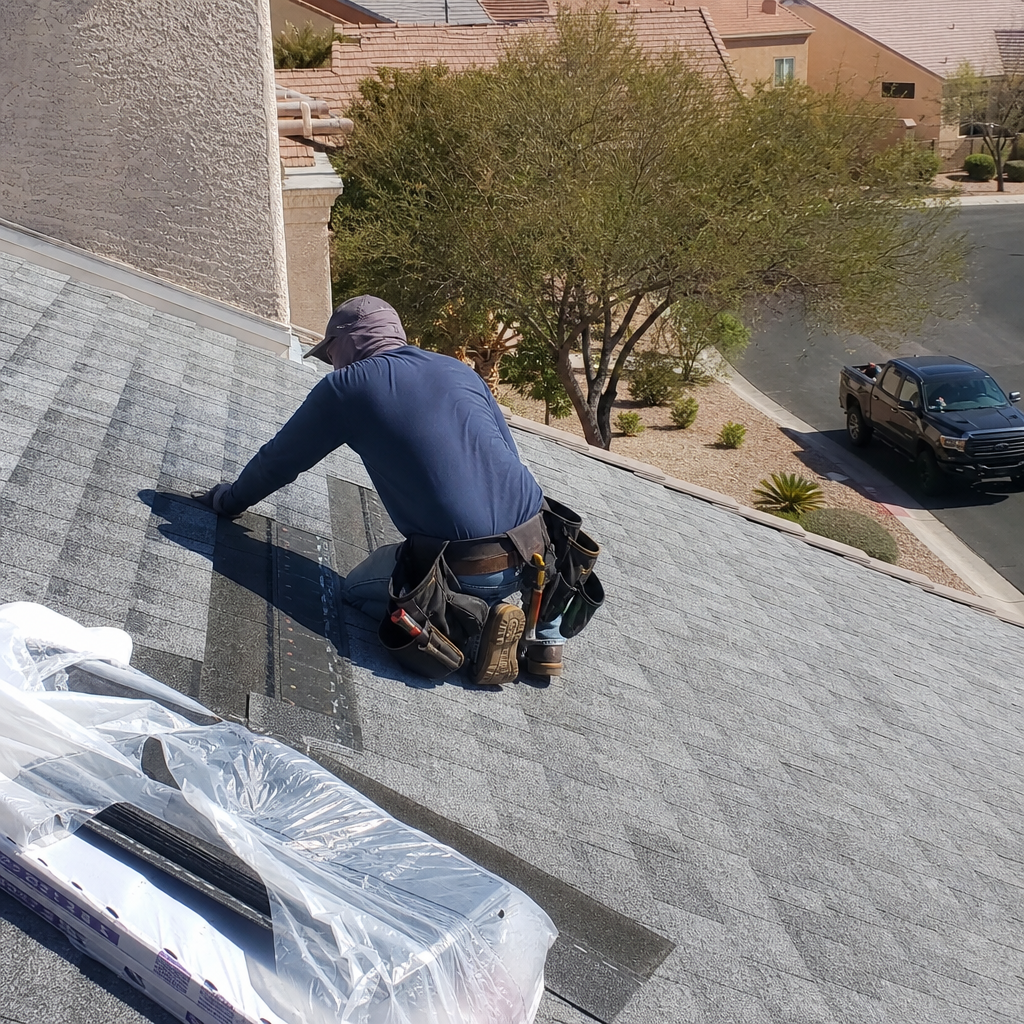
When a Winchester flat roof takes a hit during a late-summer monsoon, the first priority is stopping active water infiltration before it wicks deeper through insulation boards and membrane layers. We carry heavy-gauge emergency tarps specifically suited to low-slope and flat roof configurations — ballasted against the existing gravel surface common on 89169’s older built-up roofs, not just draped and weighted with sandbags that shift overnight. Speed matters here: every hour of open exposure on a 1970s modified bitumen membrane is additional interior damage working its way down through the building.
Storm Damage Repair
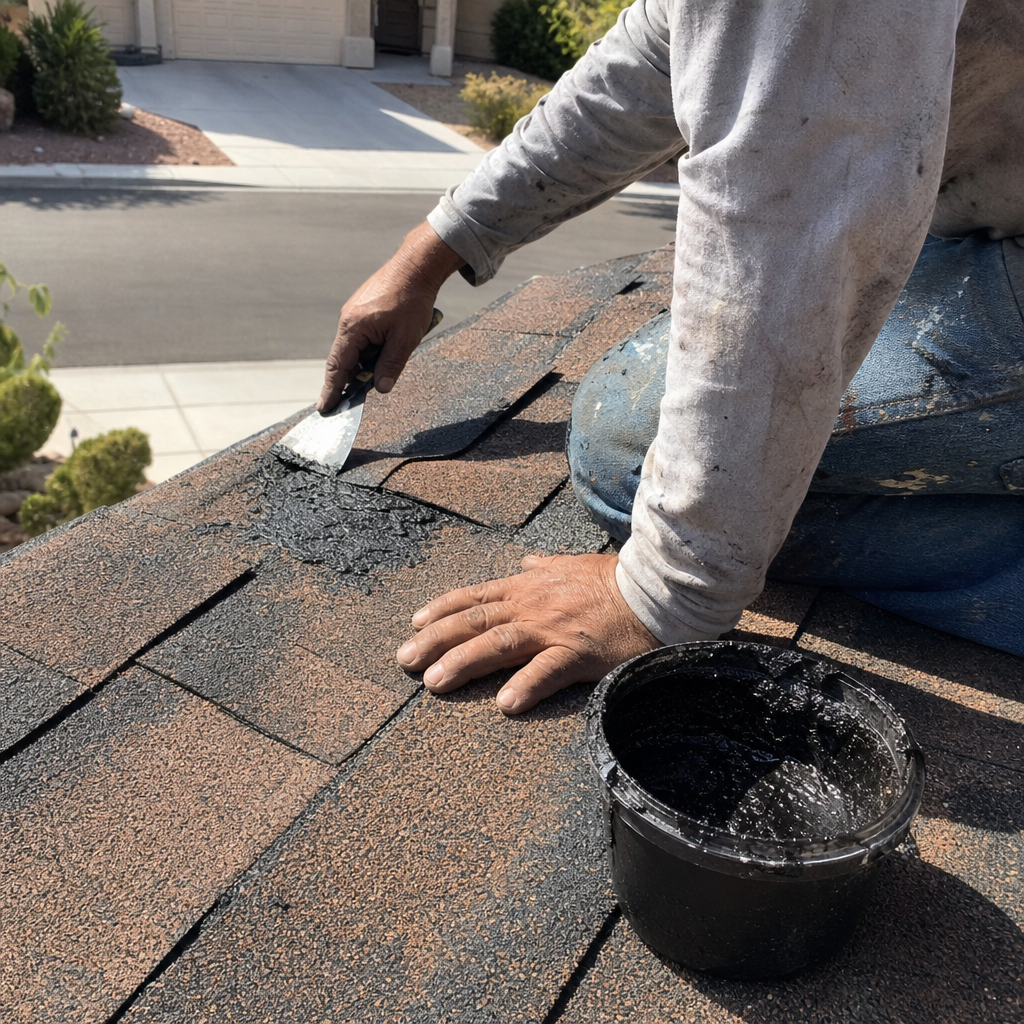
Winchester’s aging flat and low-slope roofs — the modified bitumen and built-up gravel systems that dominate the mid-century apartment blocks east of the Strip corridor — develop storm damage that looks deceptively minor from street level. A failed seam, a cracked sealant joint around a rooftop penetration, a section of membrane bubbled and split by 110°F+ summer heat — these become full breaches the moment a monsoon pushes an inch of water across the surface in under two hours. We assess the full membrane condition, not just the obvious wet spot, because in Winchester’s housing stock, the visible damage and the actual damage are rarely in the same place.
Insurance Claims Assistance
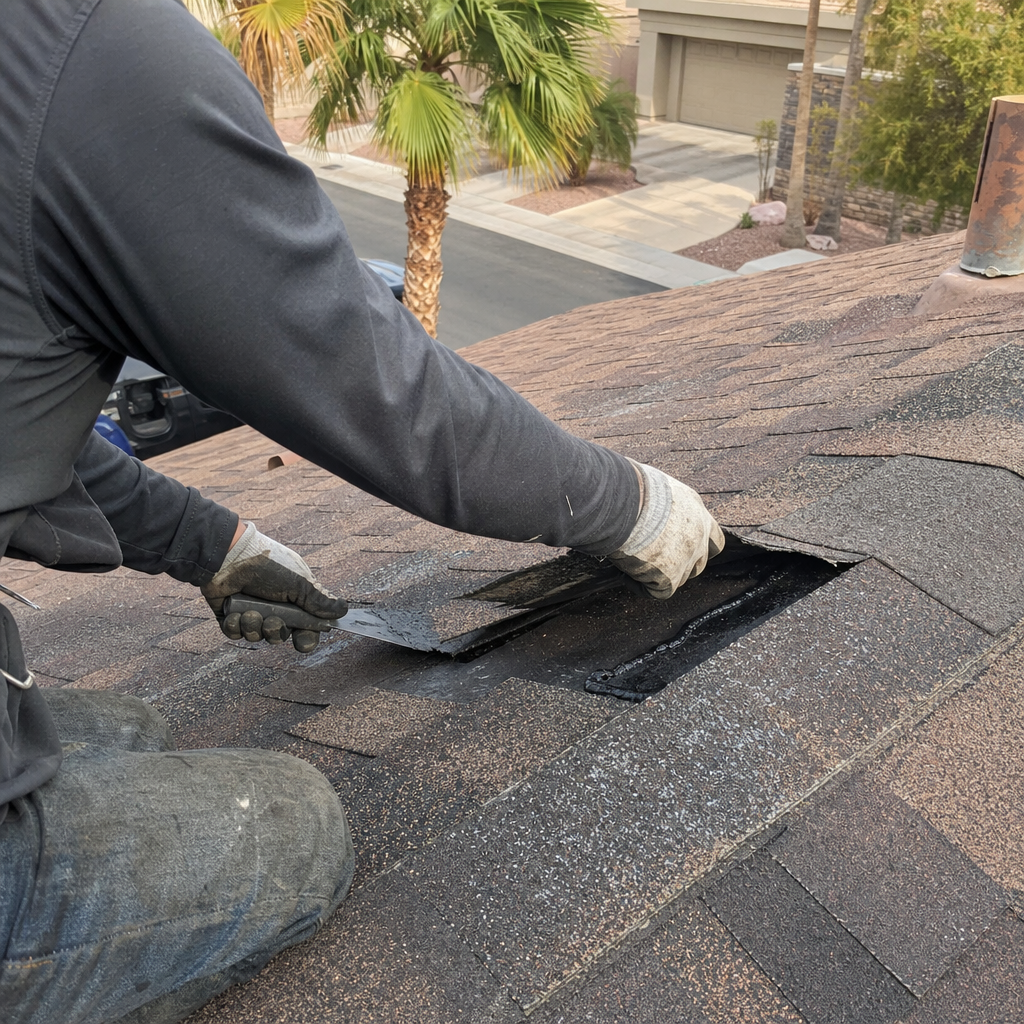
Filing a storm damage claim on a Winchester apartment building or older residential property requires documentation that most adjusters aren’t trained to interpret. Field-improvised HVAC curb flashings, decades-old modified bitumen repairs, and monsoon-driven ponding damage on roofs built without adequate drainage — these aren’t line items in a standard adjuster’s manual. We photograph and document the specific failure conditions in terms insurance carriers recognize, including the distinction between pre-existing UV degradation and acute storm-event damage, so your claim has the evidence it needs to move forward rather than getting pushed back as a “maintenance issue.”
Wind Damage Repair
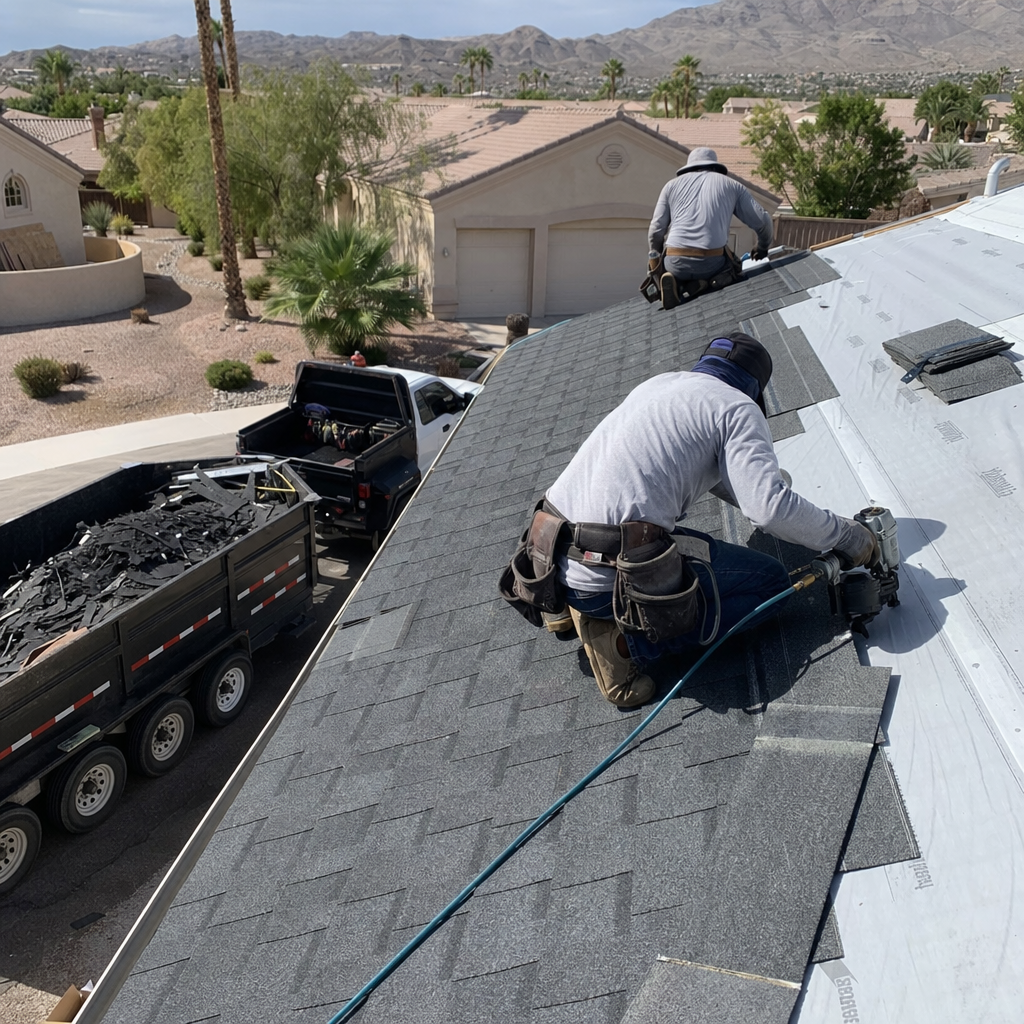
Winchester’s position in the greater Las Vegas valley means wind events — particularly the gusty downbursts that accompany monsoon cells — can lift membrane edges, dislodge gravel ballast, and separate flashing at parapet walls on low-slope roofs throughout the 89169 ZIP. On the older residential ranch homes in the grid west of the Strip corridor, wind-driven debris and lifted shingle edges are common after any significant storm system. We assess uplift damage systematically, starting at ridges, rakes, and perimeter edges where wind load concentrates first, and we carry the materials to make repairs the same day where conditions allow.
What happens when you call
- 1
A real person answersNo phone trees — you reach a local pro.
- 2
You get an upfront price rangeHonest numbers before anyone is dispatched.
- 3
A background-checked tech heads outLicensed & insured, dispatched right away.
- 4
You approve before work beginsNothing starts until you say go.
Trusted Brands We Service in Winchester
Winchester’s older flat and low-slope roofs require membrane systems and repair materials that hold up under real desert conditions — not temperate-climate specs applied to a 110°F environment. We work with seven of the roofing industry’s most respected brands: GAF, CertainTeed, Owens Corning, IKO, Atlas, Tamko, and Boral. That range matters because the right material for a 1970s modified bitumen repair on an apartment block off Maryland Parkway is not the same material that belongs on a newer single-family ranch home in the residential grid behind the corridor. We specify based on your actual roof, not whatever happens to be on the truck.
Common Emergency & Storm Damage Problems We See in Winchester Homes
- Monsoon ponding on original flat-roof drains: Winchester’s 1960s–1980s apartment blocks and motel-conversion buildings were designed for an arid climate that averages under 4 inches of annual rain — not for monsoon events that drop that entire total in a few hours. Original roof drains on these buildings clog, settle, and lose capacity over decades, and standing water on a flat gravel roof doesn’t announce itself until ceiling tiles are already wet.
- HVAC curb flashing failures on apartment rooftops: Across the 89169 corridor, rooftop HVAC units were added to existing buildings years after original construction — curb-mounted with field-cut flashings rather than engineered membrane tie-ins. These improvised seams are the first point of failure in any monsoon, and because water travels laterally through insulation before finding a penetration, interior ceiling damage frequently appears one or two floors below the actual breach. Emergency responders who don’t know this pattern tarp the wrong area entirely.
- UV and heat-accelerated membrane failure: Product specs for roofing sealants, coatings, and membrane seams are generally written for temperate climates. In Winchester, where summer temperatures regularly exceed 110°F and UV intensity is extreme year-round, those same products fail years ahead of schedule. A membrane that passed a spring inspection can have open seams by the first July monsoon — thermal cycling alone will work open a joint that looked intact in March.
- Wind-lifted perimeter flashing and gravel displacement: Monsoon downbursts create short-duration but intense wind loads on Winchester’s flat roofs, separating metal edge flashings at parapet walls and blowing gravel ballast off membrane surfaces. Exposed membrane without ballast degrades rapidly in direct sun, and a lifted parapet flashing creates an immediate water entry point at the building edge — one of the less visible but more consequential post-storm failures we see regularly across the 89169 ZIP.
The Winchester Leak Pattern You Need to Understand
No neighboring suburb has quite the same combination of conditions as Winchester’s 89169 corridor — and that combination produces a leak pattern that catches property owners completely off guard. The mid-century apartment blocks and motel-conversion properties packed into this stretch between the Strip and the residential grid east of it were built as flat-roofed structures in an era before rooftop HVAC was standard. When air conditioning became necessary — and in Las Vegas it always does — units were added to those rooftops with curb flashings cut and fitted by individual crews, not engineered into the original membrane system. No neighboring Las Vegas suburb has this same density of retrofitted commercial-style penetrations on residential flat roofs that were never designed to receive them.
Here’s what that means in practice: when a late-August monsoon drops over an inch of rain on the 89169 ZIP in under two hours — and it happens every season — water finds those improvised curb flashings immediately. It doesn’t stay on the roof surface. It channels through the gap between the curb and the membrane, wicks laterally through decades of insulation board, and eventually finds a penetration or a seam through which it descends into the building. Interior ceiling damage then appears one or two floors below the actual breach point. The tenant on the second floor calls the manager. The manager looks at the ceiling above and sees nothing wrong. The actual failure is on the roof, two units over and one floor up, at an HVAC curb flashing that was improvised in 1987.
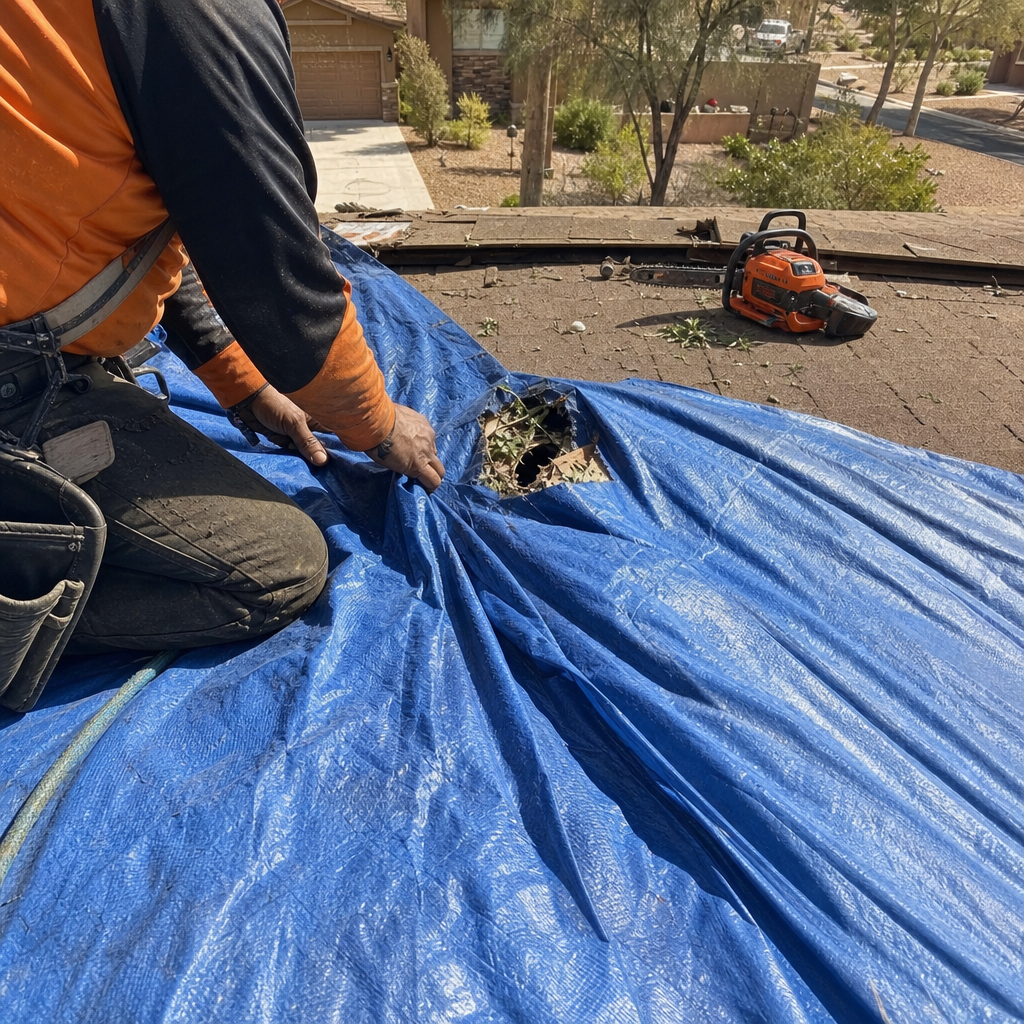
We’ve seen this pattern enough times in Winchester to know where to look first. Our crew responded to a four-unit apartment block on the residential grid just west of the Strip corridor after a late-August monsoon dropped over an inch in under two hours — the building’s original 1970s modified bitumen membrane had a failed improvised HVAC curb flashing that channeled water straight into the second-floor ceiling of a unit below. We isolated the breach with a heavy-gauge emergency tarp anchored to the existing gravel ballast, then documented the full flashing failure and ponding drainage deficiency for the owner’s insurance claim, capturing photo evidence of the field-improvised curb detail that adjusters rarely recognize as a covered manufacturing-era deficiency. That documentation made a material difference in how the claim was processed.
Pricing for Emergency & Storm Damage in Winchester, NV
Winchester property owners deserve straight numbers, not a shrug and “it depends.” Here’s what emergency and storm damage work actually runs in this market:
- Emergency tarp installation (flat/low-slope roof): $350–$650 for a standard residential section; larger apartment block or commercial coverage runs $650–$1,200 depending on roof area and accessibility.
- Storm damage repair (membrane patch, flashing repair): $400–$900 for isolated repairs on modified bitumen or built-up gravel systems common in the 89169 ZIP.
- HVAC curb flashing repair/re-flashing: $450–$850 per unit, depending on curb size and the condition of the surrounding membrane — a common repair across Winchester’s older apartment stock.
- Insurance claim documentation and inspection: Included with the storm damage assessment at no additional charge.
- Full flat-roof repair with drainage correction: $1,800–$4,500 for partial re-membrane work on a typical mid-century apartment section, depending on square footage and membrane system.
Costs shift based on roof size, membrane age, accessibility, and how much water infiltration has already occurred before we arrive. What doesn’t shift: we’ll give you a clear, itemized number before any work starts. Call (725) 529-9119 for a free on-site estimate — same day when conditions allow.
We Also Serve Cities Near Winchester
Along with Winchester, Total Roof Protection Specialists handles emergency and storm damage response across the surrounding communities — including Paradise, Las Vegas, Spring Valley, and Whitney. If a monsoon or wind event has hit your roof anywhere in this corridor, we’re already familiar with the housing stock, the common failure modes, and the fastest routes to get there.
Serving Winchester, NV — Our Local Coverage Area
We’re based in the Winchester area and know this community well. Use the map below to see our service coverage — if you’re nearby, we can almost certainly help.
FAQs — Emergency & Storm Damage in Winchester
The ceiling damage is appearing below the breach because water is traveling laterally through the roof insulation before it finds a path down — a failure pattern directly tied to how rooftop HVAC units were installed on 89169’s older buildings. When those units were added to mid-century flat-roofed apartment blocks in Winchester, they were curb-mounted with field-improvised flashings rather than engineered membrane penetrations. Water enters at that curb seam, wicks through insulation boards horizontally, and drops into the building through an unrelated penetration or seam — sometimes two full units away from where the ceiling is wet. The only way to find the actual breach is to trace the water path from the roof down, not from the ceiling up. Call (725) 529-9119 and we’ll locate the actual source, not just the symptom.
Yes — and this is one of the most important things Winchester property owners need to understand. Clark County’s annual average is under 4 inches, but monsoon events from July through September can deposit that entire amount in a matter of hours. Winchester’s flat and low-slope roofs were engineered for an arid climate, not flash-flood-volume rainfall. Original drains can’t handle that flow rate, membrane seams already degraded by 110°F+ summer heat fail immediately under standing water, and any drainage flaw becomes a ponding event in minutes. Annual rainfall totals are irrelevant — what matters is how much water hits your roof in two hours. Call us at (725) 529-9119 after any monsoon event for a free post-storm assessment.
Stop water from moving deeper into the building — that’s the single most important thing in that first hour. If you can safely access the roof, note where water is standing and whether any membrane edges, flashings, or HVAC curb areas are visibly open or displaced. Do not attempt to pull back gravel or lift membrane sections yourself. Call us immediately at (725) 529-9119 — we carry emergency tarps suited specifically to flat and low-slope configurations and can mobilize fast to Winchester addresses. While you wait, document everything with your phone camera: interior ceiling stains, exterior visible damage, and the roof surface if you can see it safely from a ladder or window. That documentation supports the insurance claim and helps us find the breach faster on arrival.
It depends on how the damage is documented — and this is exactly where the right documentation makes or breaks a claim. Insurers often push back on flat-roof claims in Winchester by attributing damage to pre-existing wear rather than the storm event. But UV degradation and heat-accelerated membrane failure in the 89169 market happen faster than product specs predict, and a monsoon can cause acute new damage on a roof that was functionally intact before the event. We photograph and document the specific storm-event damage separately from pre-existing conditions, including evidence of the improvised penetration details common to Winchester’s older apartment stock that adjusters rarely flag as covered manufacturing-era deficiencies. Call (725) 529-9119 and we’ll assess what you have before your adjuster does.
We work with seven major roofing brands — GAF, CertainTeed, Owens Corning, IKO, Atlas, Tamko, and Boral — which gives us real flexibility when specifying repair and replacement materials for Winchester’s varied older roof systems. For modified bitumen and built-up gravel systems common in the 89169 corridor, we match repair materials to the existing membrane type rather than defaulting to whatever’s easiest to source. That compatibility matters: mismatched repair materials on an aging flat roof in Winchester’s thermal environment will fail faster than a properly matched system. If you’re not sure what system your building has, we’ll identify it during the inspection. Call (725) 529-9119 for a free estimate.
Reviewed by Jose Diaz, Owner & Lead Technician at Total Roof Protection Specialists, serving Winchester and the greater Las Vegas area for 18 years.