
Last updated June 27, 2026
Roof Repair Maintenance Checklist for Las Vegas Homeowners
The number one thing we find on roofs that haven’t been touched in three years isn’t cracked shingles — it’s failed pipe boot flashings. They fail quietly, they fail predictably, and a $40 part prevents a $4,000 ceiling repair. Las Vegas homeowners tend to think about their roofs only after a water stain appears on the ceiling, but the warning signs that lead to that stain are sitting right there in plain sight — sometimes for months before a single drop of water gets in. This guide gives you the exact checklist we use after 18 years on Las Vegas rooftops, built specifically for this desert climate, not copied from a generic national template.
Quick Answer
A complete roof maintenance checklist for Las Vegas homeowners covers 11 specific inspection points — from pipe boot flashings and ridge cap condition to valley flashing, AC curb seals, and low-slope membrane edges. In our climate, the biggest failure triggers are UV degradation from extreme heat, thermal shock from rapid temperature swings, and wind-driven debris during monsoon season. Inspecting twice a year — once in spring before summer heat peaks, and once after monsoon season ends in September — catches the vast majority of problems before they become interior damage.
Table of Contents
- The 11 Inspection Points That Actually Matter in Las Vegas
- How to Safely Inspect Your Roof From the Ground
- Post-Monsoon Inspection Protocol
- What You Can DIY vs. What Requires a Licensed Contractor
- Why a Documented Maintenance Log Protects Your Insurance Claim
- Common Mistakes to Avoid
- When to Call a Professional
- Frequently Asked Questions
The 11 Inspection Points That Actually Matter in Las Vegas
Generic roof checklists were written for climates that get moderate sun, regular rainfall, and mild temperature swings. Las Vegas is none of those things. We’re dealing with UV index readings that rival the Sahara, summer roof surface temperatures that routinely hit 160°F, and monsoon events that dump an inch of rain in 45 minutes on a roof that was bone-dry for six weeks. Here are the 11 points that a proper Las Vegas inspection must cover:
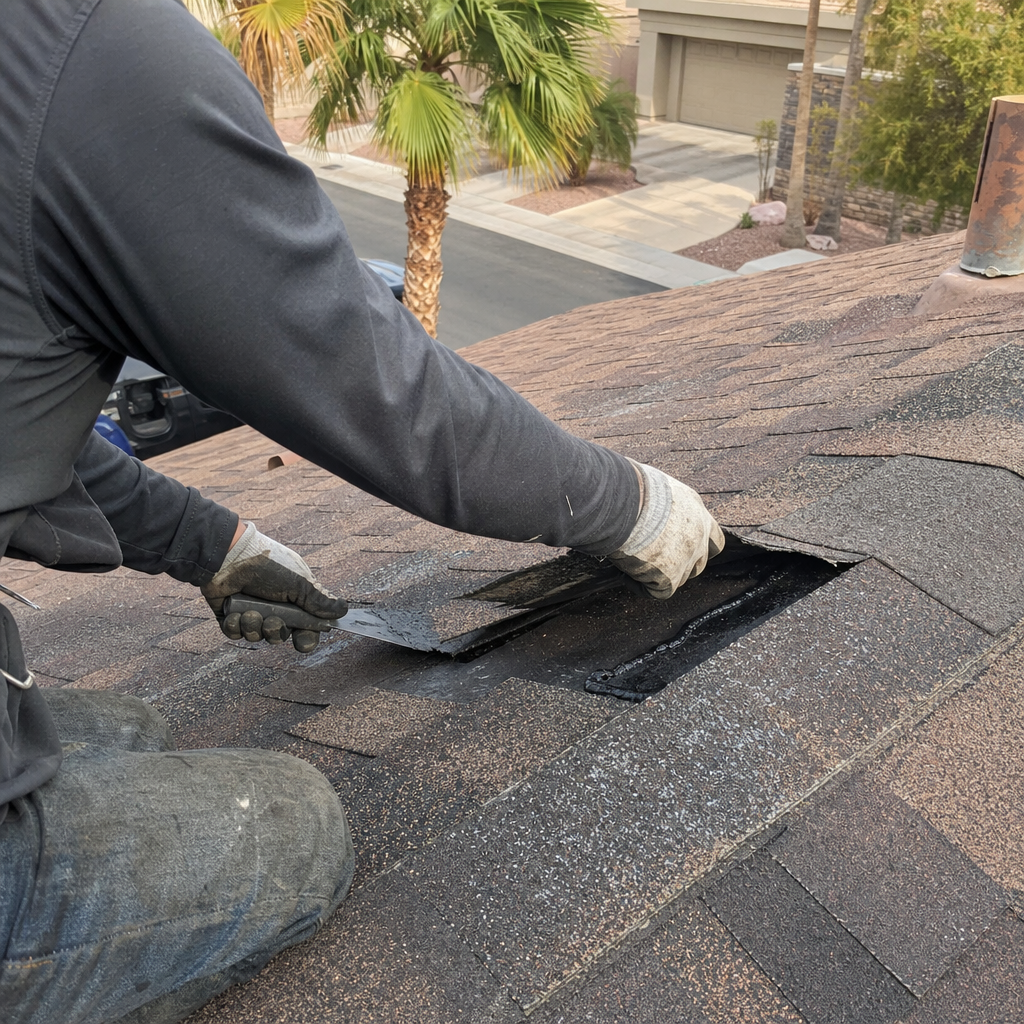
- Pipe Boot Flashings — Rubber or neoprene pipe boots are the single most common failure point we see. UV radiation hardens and cracks the collar in as little as 5–7 years. Check every plumbing vent stack for cracking, separation from the pipe, or visible gaps.
- Ridge Cap Condition — The ridge cap takes the most direct sun exposure of any shingle on the roof. Look for lifting, curling at the tabs, or missing nails that allow wind to pull it up during monsoon gusts.
- Valley Flashing — Closed-cut or open metal valleys collect debris during wind events. Look for granule buildup that creates a dam, rust staining on metal valleys, or cracks where the flashing meets the shingles.
- AC Curb Seals — Most Las Vegas homes have rooftop HVAC units. The curb seal — the gasket between the unit base and the roof deck — dries out and pulls away from the curb over time. This is a silent leak source directly above your mechanical equipment.
- Low-Slope Membrane Edges — Many Las Vegas homes have a combination roof with both pitched shingle sections and flat sections covered in modified bitumen or TPO membrane. Check the termination bar and edge lap seals for lifting or bubbling.
- Skylight Curb Flashing — Skylights are common in Las Vegas construction. The step flashing and counter-flashing at the curb can separate under thermal expansion. Look for daylight gaps or sealant that has cracked and pulled away.
- Fascia and Soffit Condition — Painted wood fascia is common in homes built before 2005 in neighborhoods like Summerlin, Green Valley, and Henderson adjacent areas. UV and heat cycling cause paint to crack, allowing moisture infiltration during monsoon season.
- Gutter Attachment and Slope — Gutters that have pulled away from the fascia create a water channel directly behind the gutter and into the fascia board. Check that hangers are intact and that the gutter still slopes toward the downspout.
- Shingle Granule Loss — After a monsoon event, check your gutters for heavy granule accumulation. Some granule loss is normal on older roofs; significant accumulation in a single season means the shingle mat is exposing.
- Chimney Crown and Cap — For homes in the northwest Las Vegas corridor and older custom builds with masonry fireplaces, the chimney crown is a freeze-thaw failure point in winter. Check for cracking and make sure the cap is seated and secure.
- Attic Ventilation Indicators — You don’t have to get on the roof to check this one. On a hot summer afternoon, if your attic is above 150°F and your ridge vent or soffit vents are blocked by insulation or debris, that heat is destroying your shingles from the underside. Even GAF, Owens Corning, and CertainTeed warranty language references adequate ventilation as a condition of coverage.
How to Safely Inspect Your Roof From the Ground
You don’t need to climb on your roof to catch 70% of the warning signs listed above. A quality pair of 8×42 binoculars and a safe vantage point from the ground — or a second-story window — will reveal most surface-level problems. Here’s how to do it properly:
- Choose the right light. Inspect in morning or late afternoon when the sun is at a low angle. This creates shadows that make lifted shingles, ridge gaps, and debris accumulation far more visible than midday flat light.
- Work in sections. Divide the roof into quadrants mentally and scan each one systematically. Start at the ridge and work down to the eave. Don’t try to take it all in at once.
- Photograph what you see. Use your phone’s zoom function to photograph anything that looks off. A photo taken today is evidence if a leak develops in six months — it shows when the condition existed.
- Check the gutters at ground level. Without touching a ladder, look into the gutter from the ground after a monsoon event. Heavy granule accumulation, standing water that hasn’t drained, or visible sagging tells you something needs attention.
- Look at the attic from inside. On a bright day, kill the attic lights and look for pinpoints of light coming through the decking. Any light means a gap. Also look for dark staining or soft spots on the OSB decking, which signal moisture infiltration.
What you can’t evaluate from the ground: the condition of pipe boot collars up close, whether a membrane lap is actually sealed or just sitting flat, the integrity of sealant at AC curbs, and any decking softness. Those require boots on the roof from someone who knows what to step on and where.
Post-Monsoon Inspection Protocol
Las Vegas monsoon season runs roughly July through mid-September, and the failure mode is different from routine UV wear. Monsoon damage is fast and mechanical — wind-driven debris, rapid saturation of dried-out sealants, and pressure differentials that pull at lifted edges. The post-monsoon inspection is a separate protocol from your spring maintenance check.
Within 48 hours after a significant monsoon event:
- Walk the perimeter of your home and look for shingle tabs or ridge cap pieces on the ground. Even one piece means the roof lost a fastener somewhere.
- Check all downspout discharge points for excessive granule deposits — a heavy monsoon can wash away years of granule in one event on a compromised shingle.
- Look at all penetrations (pipe stacks, AC curbs, skylight curbs) from the ground with binoculars. Wind creates uplift pressure at these points that can dislodge sealant that looked fine beforehand.
- In neighborhoods like Centennial Hills and North Las Vegas where construction dust and desert debris accumulate heavily, check valley channels specifically for debris dams that will redirect water on the next rain event.
Within 2 weeks after monsoon season ends (September):
- Schedule a full hands-on inspection — ideally with a roofer, but at minimum a thorough attic check from inside.
- Probe any areas where you suspect moisture with a non-destructive moisture meter before assuming you’re dry. Water migrates laterally in decking and insulation; the wet spot is often several feet from the entry point.
- Document everything before you authorize any repairs. Photos, dates, and a written description are your protection if you later file a homeowner’s insurance claim.
What You Can DIY vs. What Requires a Licensed Contractor
This is where a lot of Las Vegas homeowners make expensive mistakes — not because they’re careless, but because no one told them where the line is. Certain maintenance tasks are genuinely within a careful homeowner’s ability. Others, if done without proper licensing, will void the material warranty on products from manufacturers like GAF, CertainTeed, Owens Corning, IKO, Atlas, Tamko, and Boral. Here’s the honest breakdown:
Tasks a homeowner can reasonably handle:
- Clearing gutters and downspouts — Safe from a ladder at eave level, doesn’t affect roofing materials or warranties.
- Removing debris from the roof surface — A soft-bristle broom from the edge of the roof, or a leaf blower on an extension pole, won’t damage shingles and keeps valley channels clear.
- Applying caulk to small, isolated cracks in chimney crown mortar — A $12 tube of polyurethane sealant applied carefully to hairline cracks in the crown is legitimate preventive maintenance.
- Painting or sealing exposed wood fascia — Exterior-grade paint or a penetrating wood sealer on fascia boards is routine home maintenance.
- Replacing a single, clearly accessible gutter hanger — Straightforward hardware work that doesn’t touch roofing materials.
Tasks that require a licensed roofing contractor:
- Replacing pipe boot flashings — Requires lifting shingles, which voids warranty coverage if done by an unlicensed person under most manufacturer programs.
- Resealing or replacing AC curb flashing — Involves working with roofing membrane materials; improperly done it creates a larger leak than the one you started with.
- Any work on flat or low-slope membrane sections — Modified bitumen and TPO require specific tools, materials, and technique. A DIY patch on a flat section almost always fails within one monsoon season.
- Re-nailing or replacing ridge cap — Correct fastener pattern, fastener type, and overlap are all specified by the shingle manufacturer. Incorrect installation is detectable during a claim inspection and can result in a denied warranty.
- Valley flashing replacement — Involves integrating new metal or membrane material into existing shingle courses. The water management geometry has to be correct.
Why a Documented Maintenance Log Protects Your Insurance Claim
In our 18 years working Las Vegas rooftops, we’ve seen homeowners denied or partially paid on legitimate storm damage claims because they couldn’t demonstrate the roof was maintained. Insurance adjusters are trained to distinguish between storm damage and pre-existing deterioration. A documented log is your counter-evidence.
Here’s what a basic maintenance log entry should include:
- Date of inspection — Even a ground-level visual check counts. Log the date.
- Who performed it — Your name, or the name of the roofing contractor with their license number.
- Conditions noted — Describe what was found, including “no deficiencies observed.” A clean inspection record is as valuable as a repair record.
- Work performed — List any repairs made, materials used, and cost.
- Photo file reference — Maintain a folder on your phone or computer labeled by date. Cloud-backed photos with metadata timestamps are admissible documentation.
- Next scheduled inspection — Keep the cadence on paper. Spring and post-monsoon, every year.
When you file a claim after a monsoon strips ridge caps off half your street, the adjuster sees a homeowner who maintained the roof, not one who ignored it for five years. That distinction can be the difference between a full replacement approval and a depreciated partial payout. We’ve seen it happen on both sides of that line in Las Vegas neighborhoods from Summerlin to Henderson.
Pair your log with receipts from any contractor work. If Jose Diaz and the team at Total Roof Protection Specialists completed repairs on your roof, you’ll receive documentation you can drop directly into your log — date, scope, materials. That paper trail has real dollar value if you ever need to file.
Common Mistakes to Avoid
- Inspecting only after a leak appears. By the time water shows up on your ceiling, the entry point has typically been open for weeks or months. In Las Vegas, the dry climate slows visible damage — but the deterioration is still happening silently underneath.
- Using rooftop caulk as a permanent fix for flashing failures. We see this constantly on Las Vegas roofs — someone ran a bead of silicone over a cracked pipe boot or a lifted valley edge, called it done, and the same spot leaked again within a year. Sealant is a temporary bridge, not a structural repair.
- Skipping the post-monsoon inspection because “nothing looks wrong.” Las Vegas monsoon events create damage that isn’t always visible from the ground. A single lifted shingle tab can allow water intrusion during the next event, then re-seat itself and look fine from below.
- Power-washing the roof to remove algae or staining. High-pressure water strips granules, forces water under shingles, and can breach membrane laps on flat sections. Soft-wash or a manufacturer-approved cleaning solution is the correct approach.
- Assuming a new roof doesn’t need inspections. Even a roof installed two years ago needs to be checked. Installation defects — missed fasteners, improper flashing laps, inadequate sealant at penetrations — show up early and are far cheaper to fix before water gets involved.
- Hiring whoever shows up after a storm without verifying credentials. Storm chasers hit Las Vegas neighborhoods hard after significant monsoon events. Verify that any contractor you hire is licensed in Nevada and has a verifiable track record — not just a truck and a good pitch. A 4.9 rating across 788 reviews isn’t marketing — it’s a track record you can actually check.
- DIY-ing work that voids your material warranty. If your roof has shingles from Owens Corning, IKO, or Atlas — brands with specific installation requirement language — any non-licensed repair to those materials can legally void the warranty. Read the documentation that came with your roof before you pick up a nail gun.
When to Call a Professional
Call a licensed roofing contractor immediately if you find any of the following during your inspection:
- Water stains on ceiling drywall or attic decking — the leak source needs to be located before the next rain event.
- Any soft or spongy areas when you walk the roof — this signals decking rot that won’t get better on its own.
- Multiple failed pipe boots — if one has cracked, the others installed at the same time are close behind.
- Visible daylight through the attic decking — any gap is an open entry point for water and pests.
- Lifted or missing ridge cap after a monsoon event — exposed ridge is one of the fastest paths to attic water intrusion.
- Bubbling, ponding, or separated seams on flat membrane sections — these do not self-heal.
Total Roof Protection Specialists offers free estimates in Las Vegas — call (725) 529-9119 and Jose Diaz will give you a straight answer about what needs to happen and what it’s going to cost. No runaround, no pressure.
Frequently Asked Questions
How often should Las Vegas homeowners inspect their roofs?
Twice a year is the minimum that makes sense in Las Vegas — once in spring (March or April, before peak heat) and once in September or October after monsoon season closes. The spring inspection catches UV and winter-related degradation before summer heat accelerates it. The fall inspection catches any damage from wind-driven rain events before the weather turns cold. If your roof is more than 12 years old, we’d add a third check in late fall to assess how it handled the full thermal cycle. Call (725) 529-9119 if you want a professional set of eyes on it — estimates are free.
What does roof maintenance typically cost in Las Vegas?
Routine maintenance on a standard Las Vegas single-family home typically runs between $150 and $400 depending on roof complexity, number of penetrations, and whether any minor repairs — like replacing a failed pipe boot or resealing an AC curb — are needed at the same time. A professional inspection alone, without repairs, generally runs $100–$200. Those numbers are far easier to absorb than the $3,000–$8,000 range for interior water damage remediation after a preventable leak. Call (725) 529-9119 for an exact quote — estimates are free and there’s no obligation.
Can Las Vegas homeowners inspect their own roofs safely?
A ground-level visual inspection using binoculars is safe and genuinely useful — it catches most surface-level warning signs without any roof access. Walking on your own roof is a different question. Asphalt shingles above 120°F surface temperature are soft and more easily damaged by foot traffic, and the fall risk on a pitched roof without fall protection is significant. If you need to get on the roof, early morning in cooler months is safer, and staying on the flat sections near the ridge is preferable to working near eaves. For anything beyond a visual scan, a licensed contractor with proper safety equipment is the right call.
Does homeowner’s insurance cover roof damage in Las Vegas?
Most standard homeowner’s insurance policies in Las Vegas cover sudden storm damage — wind, hail, falling debris — but exclude damage attributed to wear, age, or lack of maintenance. That distinction is exactly why a documented maintenance log matters. If you’ve kept records showing the roof was inspected and maintained, and a monsoon event then damages it, you’re in a much stronger position with your adjuster than a homeowner who has no documentation. Always review your specific policy language and consult with your insurance agent about what your coverage actually includes for roofing.
What are the signs of heat damage on a Las Vegas roof?
The most visible sign of UV and heat damage on asphalt shingles is accelerated granule loss — the colored granules that protect the asphalt mat from UV exposure begin washing into gutters at a higher-than-normal rate. You’ll also see shingles that have curled upward at the edges (cupping) or downward at the center (clawing), which are textbook signs of thermal distortion. On flat sections, extreme heat causes modified bitumen to blister and bubble where adhesion to the substrate has failed. Shingles from brands like Roof Repair in Winchester — or rather, manufacturers like GAF, CertainTeed, and Tamko — publish heat and UV resistance specifications that give you a baseline for how long a product should hold up in this climate before it shows these symptoms.
When is roof repair enough vs. a full replacement in Las Vegas?
Repair makes sense when damage is isolated — a failed pipe boot, a handful of cracked shingles, a separated valley flashing — and the surrounding material is still structurally sound with meaningful life remaining. Replacement becomes the better investment when more than 25–30% of the shingle surface is showing active granule loss or thermal damage, when the decking has widespread moisture intrusion, or when a roof is past 20 years old and requires repeated repairs season after season. In Las Vegas specifically, roofs age faster than the national average due to UV intensity and thermal cycling — a 15-year-old roof here may be performing like a 20-year-old roof in a milder climate. Jose Diaz can walk you through that assessment honestly, without a sales pitch toward the higher-ticket option. Call (725) 529-9119 and ask.
The Bottom Line
The Las Vegas climate is hard on roofs — there’s no way around that. What you can control is whether small, fixable problems become expensive interior damage. A twice-yearly inspection covering the 11 points in this guide, a post-monsoon walkthrough after significant storms, and a simple documented log of what you found and fixed will protect your home far more effectively than any reactive repair ever will. Know what you can safely handle yourself and what requires a licensed hand. Keep the records. And when something is beyond a visual check or a caulk tube, call someone who’s been doing this in Las Vegas for 18 years and will tell you straight what it needs. That’s what we’re here for.
Ready to schedule a free inspection or get a straight answer on what your roof actually needs? Call (725) 529-9119 — Jose Diaz will pick up or call you back, and there’s no cost to find out where you stand. You can also learn more about our full range of services at Roof Replacement & Installation in Winchester, Specialty Roofing in Winchester, and across the greater Las Vegas area.
Written by Jose Diaz, Owner & Lead Technician at Total Roof Protection Specialists, serving Las Vegas since 2008.